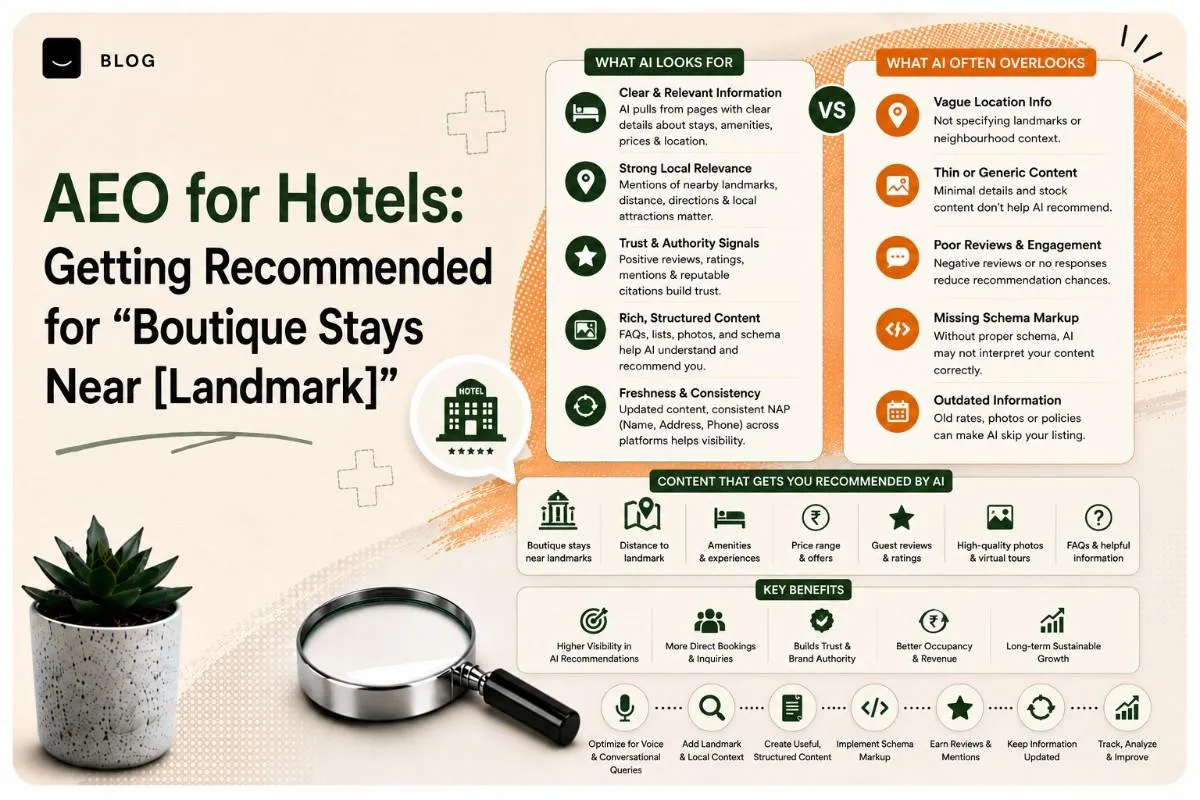
AEO for Hotels: Getting Recommended for "Boutique Stays Near [Landmark]"
AEO for hotels — answer engine optimization — is the work of getting your property named when a traveller asks an AI or a search engine where to stay. It targets AI Overviews, featured snippets and voice answers rather than a position on a results page.
For independent hotels and resorts, this matters more than for most businesses, because of one structural fact: on Google, OTAs usually outrank you for your own category terms. In AI answers, that dominance is weaker. A well-described independent property can be named alongside — or instead of — an aggregator, which makes AI search the best opening independent hospitality has had in years.
Why AI search is a rare opening against the OTAs
On a traditional results page, booking aggregators win through scale — enormous domain authority, vast inventory pages, and years of accumulated links. An independent hotel rarely outranks them for "hotels in [city]."
AI answers work differently. When someone asks a specific, constrained question — "quiet boutique hotel near [landmark] with a pool, good for a couple" — the model needs matching detail, not domain authority. It needs to know a property is quiet, boutique, near that landmark, has a pool, and suits couples.
An aggregator listing page often can't supply that specificity for one property. A hotel's own site can — if it has written it down. That's the whole opportunity, and most independent hotels haven't taken it because their sites are built to look beautiful rather than to be read by a machine.
How travellers actually search for a stay now
Travel queries have become highly conversational and constraint-heavy:
- "Where should I stay in [city] for a family with young kids?"
- "Best boutique hotels near [landmark] under ₹8,000 a night"
- "Quiet resort near [city] for a weekend, with a pool"
- "Hotels in [area] that allow pets and have parking"
- "Where to stay for a wedding at [venue]"
Every one of these carries constraints — budget, location relative to something, traveller type, amenities, occasion. The AI answers by matching those constraints against whatever it can read.
If your website doesn't state that you're family-friendly, walking distance from that landmark, pet-friendly, and have parking, you cannot be matched. Beautiful photography doesn't help here; text does.
What an AI needs to recommend your hotel
Stated plainly, on your own site, as text:
- Property type — boutique, resort, heritage, business hotel, homestay. Use the words travellers use.
- Precise location context — the area, and distance or travel time to the landmarks, stations and airports people actually reference.
- Room types and capacity — including what suits families, couples, or groups.
- Amenities as specifics — pool, parking, restaurant, wifi quality, pet policy, accessibility, air conditioning.
- Price positioning — a range or a "from" rate, even approximate, since many queries carry a budget.
- Who the property suits — couples, families, business travellers, wedding parties. Say it explicitly.
- Check-in/check-out and policies — cancellation, children, extra beds.
VERIFY: Any rates, distances or policy specifics published must be current and accurate. Outdated pricing or a wrong pet policy in an AI answer creates a real guest-experience problem, not just an SEO one.
The landmark problem — and how to solve it
"Near [landmark]" is one of the most common shapes of travel query, and it's where independent hotels lose most often.
The fix is unglamorous: write your property's relationship to nearby landmarks in plain text. Not a map embed — a map is invisible to a language model. Sentences.
Create a genuine "location and getting here" section stating distances and travel times to the landmarks, transport hubs, business districts and event venues your guests actually ask about. "12 minutes' drive from the City Palace, 4 km from the railway station, 25 km from the airport" is directly usable by an AI answering a proximity question. A pin on an embedded map is not.
If you're in a city with a wedding or event industry, name the venues. "Where to stay for a wedding at [venue]" is a high-intent query almost nobody has written content for.
Write for the constraints travellers actually have
Take the constraints from real queries and answer each one explicitly somewhere on your site:
- Family: do you have family rooms, extra beds, a kids' pool, high chairs?
- Couples: is it quiet, are there private spaces, do you do special occasions?
- Business: wifi speed, desk in room, meeting space, early check-out?
- Accessibility: step-free access, lift, accessible bathrooms?
- Pets: allowed or not — say so plainly either way.
- Parking: available, free, secure?
- Food: on-site restaurant, breakfast included, vegetarian and Jain options, room service hours?
Each of these matches a real query constraint. Most hotel websites answer two or three and leave the rest to be guessed.
Reviews: what AI reads beyond the star rating
Hospitality is review-saturated, and AI systems read review text, not just scores.
That means the language guests use becomes part of how you're described. A review saying "spotless rooms and the staff arranged a taxi at 5am without fuss" gives an AI usable detail about cleanliness and service. A five-star review saying "nice hotel" gives it nothing.
You can't script reviews and shouldn't try. But when you ask a departing guest for one, asking them to mention what they came for — a family trip, a work stay, a wedding — produces more specific, more usable reviews, honestly.
Reviews on your own Google Business Profile matter especially, because they're attached to your property as an entity rather than to an aggregator's listing of it.
Why your own site must answer what the OTA listing answers
Here's the failure mode worth naming. Many hotels treat their own website as a brand showcase — hero video, gallery, a booking button — and let the OTA listing carry all the practical detail: amenities, policies, room specifics, location context.
The consequence is that the OTA becomes the authoritative source about your property, including for AI answers. You've outsourced not just distribution but description.
The fix isn't to remove the beautiful site. It's to make sure every practical fact a traveller might filter on also exists, in text, on your own domain. Then when an AI answers a constrained question, it has your own words to draw on rather than an aggregator's summary of you.
A practical AEO checklist for hotels
- Write a real location section with distances and travel times to landmarks, stations, airport and event venues — as text, not a map.
- Describe each room type with capacity, bed configuration and who it suits.
- List every amenity explicitly, including the ones you consider obvious.
- State policies plainly — pets, children, cancellation, check-in times.
- Publish a price range or "from" rate.
- Say who the property is for — couples, families, business, weddings.
- Add an FAQ answering what guests email and call to ask.
- Complete your Google Business Profile with every attribute filled in.
- Add Hotel/LodgingBusiness and FAQ schema.
- Ask for descriptive reviews on your own profile, not only the OTA.
- Keep rates and policies current — stale information in an AI answer becomes a guest complaint at the front desk.
How to test whether AI recommends you
Ask the questions your guests would ask, in ChatGPT, Perplexity and Gemini, plus Google for an AI Overview:
- "Best boutique hotels near [your nearest landmark]"
- "Where to stay in [your city] with family"
- "Quiet hotels near [venue] for a wedding"
- Add your real constraints — budget, pets, pool, parking
Record whether you're named, whether the details are right, and which properties or aggregators appear instead. Where an OTA appears instead of you, check what its listing says that your own site doesn't. That gap is your content brief.
Conclusion
Independent hotels have spent a decade losing search visibility to aggregators with more authority. AI answers don't reward authority the same way — they reward specificity, and specificity is something a single property can genuinely own. Writing down what makes your hotel matchable is the cheapest competitive advantage currently available in hospitality marketing.
Want to know whether AI assistants are recommending your property — and what they're saying?
Contact Crescent for a free consultation.
Frequently asked questions
AEO, or answer engine optimization, for hotels is the practice of structuring a property's online information so search engines and AI assistants name it when a traveller asks where to stay. It targets AI Overviews, featured snippets and voice answers rather than only a position in search results.
Often yes, more easily than in traditional search. AI answers to constrained questions require matching detail rather than domain authority, and an aggregator listing frequently cannot supply property-level specifics. A hotel that publishes its location context, amenities, policies and guest suitability as text can be matched directly.
By writing the property's relationship to nearby landmarks as plain text — distances and travel times to landmarks, stations, airports and event venues — rather than relying on an embedded map, which language models cannot read. Naming local wedding and event venues captures high-intent queries most hotels have not written content for.
If amenities, policies and room details exist only on aggregator listings, the aggregator becomes the authoritative source describing the property, including in AI answers. Publishing the same practical facts on the hotel's own domain means AI systems can draw on the hotel's own words instead.
Yes, and the text of reviews matters alongside the score. Reviews describing specific details such as cleanliness, service or suitability for a family trip give AI systems usable information for constraint-based questions, whereas short generic reviews provide little. Reviews on the hotel's own Google Business Profile are attached to the property as an entity.
Ready to build what's next?
Tell us where you're headed. We'll come back with a plan to get there.
Book an intro call