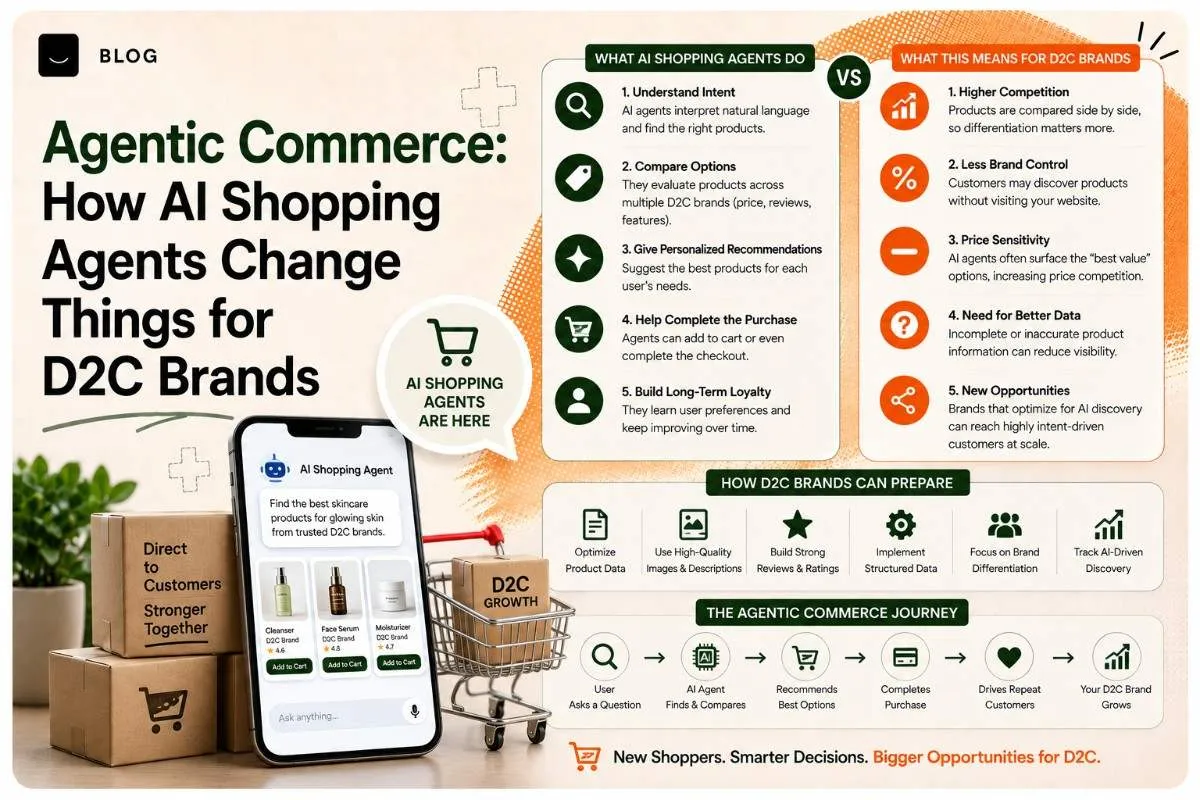
Agentic Commerce: How AI Shopping Agents Change Things for D2C Brands
Agentic commerce describes a shift in which an AI assistant does the shopping work on a customer's behalf — comparing products, evaluating options against stated requirements, and in some cases completing the purchase. For D2C brands, the practical question is not whether to prepare for a distant future, but whether your product pages currently contain the specific, structured information an AI agent would need in order to recommend you at all. Most do not.
What agentic commerce means
Ordinary ecommerce assumes a person browsing. They land on a category page, filter, compare a few options, read reviews, and buy.
Agentic commerce assumes a person delegating. They describe what they want — "a moisturiser for oily skin, fragrance-free, under ₹1,200, from an Indian brand that doesn't test on animals" — and an AI assistant does the comparing and returns a short answer, often two or three options with reasons.
The change is in who reads your product page. It used to be a person, who could interpret a lifestyle photograph, infer from a brand's tone, and be swayed by a well-designed page. Now it may be a system that extracts stated facts and ignores everything else.
The three levels, and where things actually are
It helps to separate what is already happening from what is being predicted, because a lot of writing on this subject blurs the two.
Level 1 — the agent recommends
This is here now and easy to verify yourself. Ask ChatGPT, Perplexity or Gemini to recommend a product in your category with specific constraints, and see what comes back. Brands are being named, with reasons, drawn from whatever the system could find. If your product is not in that answer, that is a present-tense problem, not a future one.
Level 2 — the agent compares and shortlists
Also largely here. Assistants will build comparison tables, weigh stated attributes against a customer's requirements, and explain trade-offs. The quality of the comparison depends entirely on the quality of the information available about each product — which is where most D2C product pages let themselves down.
Level 3 — the agent transacts
This is the part that is genuinely in motion rather than settled. Various checkout and agent-payment mechanisms are being built by different players, and the standards are not resolved. This is where the confident predictions outrun the evidence.
VERIFY: If you name specific agentic checkout products, protocols or partnerships in the published version, verify each one against a primary announcement on the day you publish. This area moves monthly, and much of the commentary about it is repeating vendor announcements as though they were shipped, widely-adopted products.
The honest position for this post: Levels 1 and 2 already affect you. Level 3 is a reason to build good product data now rather than a reason to change your business model today.
Why this is different from search
Search gives a customer options. An agent gives a customer an answer.
That difference has consequences that are easy to underestimate:
- There is no page two. Being the eleventh-best option in a search result still gets some traffic. Being the eleventh-best option in an agent's answer gets nothing, because the agent named three.
- The customer may never see your site. They see your product summarised. Your photography, your copy, your carefully-built brand page — none of it is in the room.
- Vague claims get filtered out. A person reads "gentle, nourishing formula" and forms a warm impression. An agent asked for "fragrance-free, under ₹1,200" cannot do anything with it.
- Specificity wins over polish. A plain page with a complete attribute table beats a beautiful page with the same information buried in a lifestyle image.
This is Generative Engine Optimization applied to product data. The mechanism is the same one that decides which sources an AI answer cites — it is just operating on your catalogue rather than your blog.
What an agent can and cannot read on your product page
Readable and usable:
- Product attributes stated as text — size, weight, material, ingredients, compatibility, certifications
- Structured data, especially Product, Offer and AggregateRating schema
- Price, currency, and availability as marked-up data rather than only as rendered text
- Clear, factual product descriptions
- Review text
- Shipping, returns and warranty terms stated in words
Not readable, or unreliable:
- Anything that exists only inside an image — spec charts, ingredient lists, size guides, comparison graphics. This is extremely common and quietly costly.
- Attributes that live only in a dropdown or a filter, never as text on the page
- Claims implied by design or photography rather than stated
- Content behind a tab that does not render without interaction
- Anything in a downloadable PDF
The single most common gap on Indian D2C sites, worth checking today: a size, spec or ingredient chart that exists only as a JPEG. A person reads it fine. An agent sees nothing.
The five things a D2C brand should fix now
None of these require a strategy offsite. They are catalogue hygiene, and they pay off in ordinary search too.
- Put every attribute in text. Every specification, ingredient, dimension and compatibility note as readable text on the page. If it is only in an image, transcribe it.
- Implement complete Product schema. Name, description, brand, SKU, price, currency, availability, and review data. Incomplete schema is the norm, which means complete schema is a differentiator.
- Write descriptions that answer purchase questions, not brand questions. Who it suits, who it does not, how it compares to the obvious alternative, what it does not do. The "who it does not suit" line is unusual enough to be genuinely valuable — and an agent matching a customer's constraints uses exclusions as readily as inclusions.
- State policies in plain text. Shipping timelines, returns window, warranty terms, country of origin. These are frequently part of what a customer asks an agent to check.
- Make review text substantive. Star ratings are a number; review text is description. Encourage specific reviews, and reply to them.
What this does to the parts of marketing you have been investing in
Three shifts worth thinking through, stated as tendencies rather than certainties:
Product data becomes a marketing asset, not an operations chore. In most D2C teams, the product feed is maintained by whoever has time. If agents mediate discovery, that spreadsheet becomes as important as the campaign calendar.
Comparison content becomes more valuable, not less. Honest comparison pages — including ones where you lose on some dimension — are exactly the material an agent draws on when a customer asks it to compare. Brands that only publish content in which they win give an agent nothing balanced to work with, and balanced sources are the ones these systems favour.
Paid acquisition does not disappear, but a chunk of discovery may move outside it. Nobody sensible can tell you how much or how fast. What is defensible: if a share of purchase research moves to agents, that share is not addressable by the paid channels you currently buy, and the only thing that makes you visible in it is being genuinely well-described.
The uncomfortable question: what happens to brand?
If an agent evaluates on attributes, does brand still matter?
The honest answer is that nobody knows, and anyone giving you a confident one is guessing. But two things point in a specific direction.
First, agents are not purely attribute-matching machines. They draw on reviews, editorial coverage, forum discussion and general reputation — all of which are brand, expressed as text. A brand people write positively about has more material feeding into that answer than one nobody discusses.
Second, the customer still receives the answer. A recommendation for a brand someone has heard of lands differently from one for a name they have not. Agents narrow the shortlist; the human still makes the final call more often than not.
The reasonable conclusion is not that brand stops mattering, but that brand expressed only through visual identity and tone becomes less legible, while brand expressed through what people say about you becomes more so. For a D2C brand, that argues for the unglamorous work: reviews, coverage, community, and comparison content that is honest enough to be quoted.
What we do not know yet
Stated plainly, because this post would be dishonest without it:
- What share of purchase decisions actually route through agents, in India or anywhere. Estimates circulate; most are vendor projections.
- Which transaction standards will win, or whether the major platforms will interoperate at all.
- Whether agents will favour marketplaces over brand sites, which would change the calculation considerably.
- How commercial arrangements will affect what agents recommend, and how visible those arrangements will be.
None of this uncertainty changes the recommendation. Complete product data, real structured markup, and honest comparison content improve conversion, ordinary search visibility, and marketplace performance regardless of what happens with agents. That is what makes it a safe bet rather than a speculative one — the work pays off even if the prediction is wrong.
Frequently asked questions
Agentic commerce describes shopping in which an AI assistant performs the work on a customer's behalf — interpreting requirements, comparing products, evaluating options and, in some emerging cases, completing the purchase. The customer describes what they want rather than browsing, and receives a short recommendation instead of a list of results.
Partly. AI assistants already recommend and compare products in response to detailed requirements, which affects D2C brands today and can be tested in minutes. Fully autonomous purchasing by agents is less settled, with several competing approaches and no agreed standard, so claims about it should be checked against primary announcements.
They work from the information they can read — product attributes stated as text, structured data such as Product schema, prices, availability, policies, and review content. Information that exists only inside images, PDFs or interactive elements is largely invisible to them, which is why detailed pages can still be poorly represented.
Start with product data. Put every specification and ingredient in readable text rather than in images, implement complete Product schema, write descriptions that answer purchase questions including who the product does not suit, state shipping and returns policies in plain words, and encourage substantive review text.
Brand expressed only through visual identity and tone becomes harder for an agent to read, while brand expressed through reviews, coverage and public discussion becomes more important, since that is text these systems draw on. The customer also still makes the final decision, and recognition affects how a recommendation lands.
There is no reliable basis for predicting that. What can be said is that a portion of product research is already moving to AI assistants, and that portion is not reached by traditional search or paid channels. Preparing for it involves the same work that improves conventional search performance anyway.
It is arguably more relevant for smaller brands, because agent recommendations are driven by how well a product matches a stated requirement rather than by advertising budget. A small brand with complete, specific product data can appear in an answer alongside far larger competitors whose pages are vaguer.
Ready to build what's next?
Tell us where you're headed. We'll come back with a plan to get there.
Book an intro call