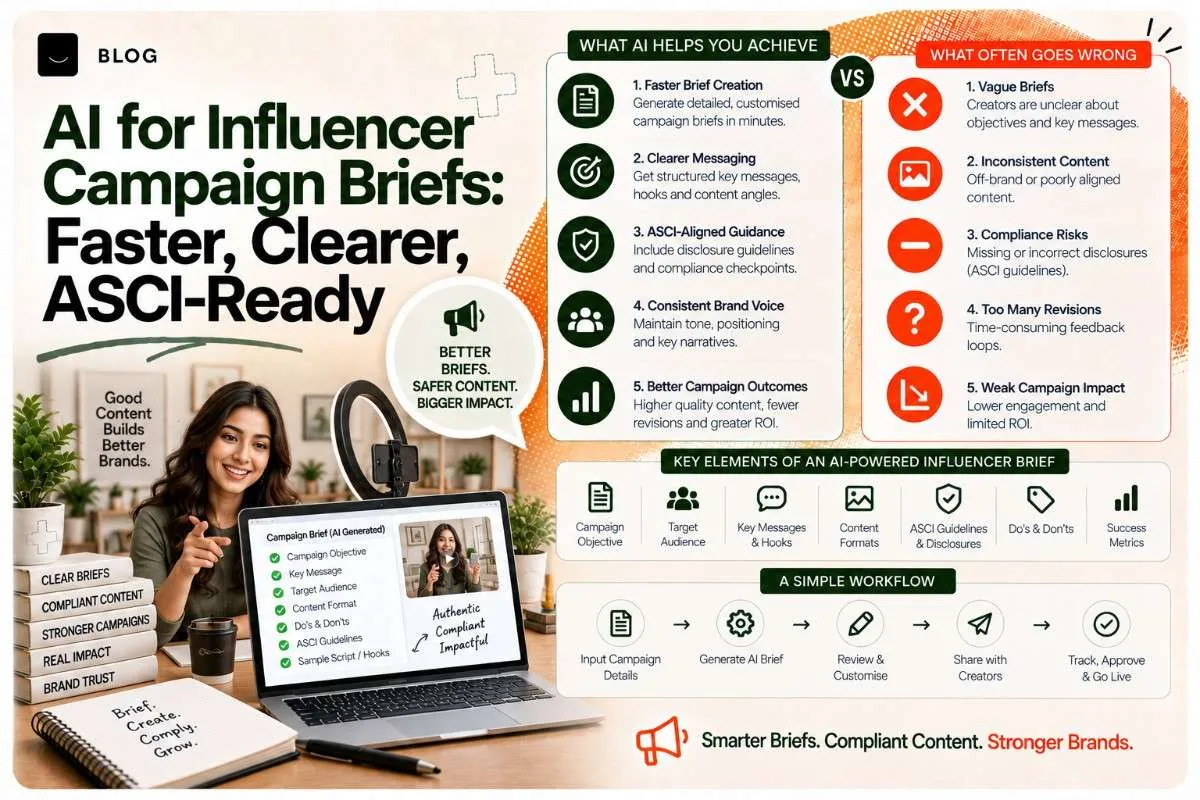
AI for Influencer Campaign Briefs: Faster, Clearer, ASCI-Ready
A campaign brief written after creative direction, with disclosure requirements bolted on at the end, produces content that technically discloses and still reads as an afterthought. A brief that states disclosure requirements as part of the campaign concept from the first draft produces content where the disclosure sits naturally. AI is well suited to drafting a brief this way — it does the structuring quickly once a person supplies the actual requirements and the actual product truth.
A note on scope, before anything else
This post covers how to structure an influencer brief so disclosure and compliance considerations are built in from the start, using AI to draft it faster. It does not restate India's advertising disclosure rules in full — that ground is covered properly in our post on building an influencer campaign that passes ASCI review, which should be read alongside this one and is linked throughout.
Rules in this area change, and a second summary living in a second post is exactly how content drifts out of date without anyone noticing. Anything below referring to a specific requirement points to that post or to primary ASCI guidance rather than restating it here.
Why disclosure usually gets added late, and why that is the problem
The common failure pattern in influencer briefs, and it is worth naming because it explains why AI genuinely helps here.
A brief gets written around the creative idea first — the concept, the tone, the deliverables, the hashtags. Disclosure gets added at the end, often as a single line: "must include #ad." The creator receives a brief that is detailed about creative direction and thin about compliance, and treats it accordingly — the disclosure becomes a tacked-on afterthought in the content rather than something integrated into how the post is framed.
The fix is not a longer disclosure line. It is writing the brief so disclosure requirements are stated at the same level of detail as the creative direction, from the first draft, because a brief is a specification and creators follow what is specified in proportion to how much attention it was given.
What a brief needs to contain
A complete brief, regardless of format, needs each of these as an actual section, not a line buried in another one:
- Campaign concept and what the brand actually wants said — specific, not vague enthusiasm
- Product truth — what the product does, what it does not do, any claim that must not be made
- Deliverables — format, count, platform, rough timing
- Creative direction — tone, what to avoid, examples if useful
- Disclosure requirements, stated as specifically as the creative direction — where the disclosure goes, in what form, at what point in the content
- Approval process — who reviews, what the turnaround is, what happens if something needs to change
- What the creator must not claim — a short, explicit list, not assumed knowledge
The last two are the ones most briefs skip, and they are the ones that prevent the most common problems.
The prompt template
You are drafting an influencer campaign brief for a brand-creator collaboration in India. Disclosure requirements must be integrated throughout the brief at the same level of detail as the creative direction, not added as a single line at the end. BRAND: [name, what it sells] PRODUCT OR SERVICE: [what is being promoted] VERIFIED PRODUCT FACTS: [what the product actually does — paste accurate detail, not marketing language] CLAIMS THAT MUST NOT BE MADE: [anything the brand cannot substantiate — results, comparisons, health or efficacy claims, guarantees] CAMPAIGN GOAL: [awareness, launch, review, etc.] DELIVERABLES: [format, platform, number of posts, rough timing] CREATIVE DIRECTION: [tone, examples, what to avoid] DISCLOSURE REQUIREMENT: [paste your verified current disclosure requirement — do not have the model generate this from general knowledge] APPROVAL PROCESS: [who reviews, turnaround time] Write a structured brief covering: campaign concept, product truth and prohibited claims, deliverables, creative direction, disclosure requirements (integrated at the same level of detail as creative direction, not appended), and approval process. Rules: - Do NOT generate or infer disclosure requirements from general knowledge. Use only what I supplied above. If I have not supplied a disclosure requirement, write [NEED: current disclosure requirement — verify before sending] instead of guessing. - Do NOT invent product claims, results, or comparisons. Use only the verified facts provided. - State the prohibited claims list as plainly as the deliverables list — do not soften it into a footnote.
Two things in that prompt are load-bearing. First, disclosure requirements are supplied by the person, never generated by the model — rules in this space change, and a model's general knowledge of them may be outdated or simply wrong. Second, the [NEED] fallback means an incomplete brief is visibly incomplete rather than silently missing something important.
What AI is good at in a brief, and where a human must step in
Good at: structuring a complete brief from rough notes, writing creative direction clearly, drafting the tone and voice guidance, producing a brief that reads as organised and professional rather than a list of bullet points, and — usefully — flagging internal inconsistency, such as a claim in the creative direction that contradicts the prohibited-claims list.
Requires a human, every time: the actual disclosure requirement, which must come from current verified guidance, not the model's training data. The prohibited-claims list, which requires someone who knows what the brand can actually substantiate. Final review before the brief goes to a creator. Any judgment about whether a specific creative idea, once drafted, still complies once you can see it concretely rather than as an abstract instruction.
The review pass, every time
Before a brief goes out:
- Confirm the disclosure requirement in the brief is the current one, checked against primary guidance — not carried over from a previous brief that may now be outdated.
- Confirm every claim the brief permits is one the brand can substantiate.
- Read the creative direction and check it does not implicitly suggest a claim the prohibited list rules out — this is the most common gap, where the disclosure section is correct but the creative direction quietly contradicts it.
- Resolve every [NEED] flag.
- Have whoever holds compliance responsibility for influencer content sign off, not just whoever wrote the brief.
Step 3 catches more problems than any other step, because creative direction and compliance are usually drafted by different parts of a brief and nobody checks they agree with each other.
A brief is not a contract
Worth stating plainly. A well-written brief sets expectations; it does not replace the actual contractual and legal documentation a campaign needs. Disclosure obligations, in most frameworks, sit with the person publishing the content as well as the brand commissioning it — a brief that states requirements clearly protects both parties by making the expectation unambiguous, but it is not a substitute for whatever formal agreement your legal process requires.
A workable workflow
- Gather the inputs first — verified product facts, current disclosure requirement, prohibited claims list. This is the step that cannot be skipped or generated.
- Draft with the prompt template.
- Run the five-point review pass, particularly step 3 above.
- Get compliance sign-off, separate from creative sign-off.
- Send the brief, and keep a record of the version sent — useful if a question arises later about what was actually specified.
- When content comes back, check it against the brief specifically for disclosure placement and claims, not only for creative quality.
Frequently asked questions
Yes, for structuring, creative direction and organising a complete brief from rough notes. It should not be used to generate the actual disclosure requirement or any product claim — those must come from verified current guidance and accurate product information supplied by a person, because a model's general knowledge of disclosure rules may be outdated or incorrect.
Disclosure requirements are commonly added as a single line at the end of a brief, after the creative concept has already been detailed. Creators tend to follow what a brief specifies in proportion to how much attention it was given, so a disclosure line treated as an afterthought produces content where the disclosure reads as an afterthought too.
Campaign concept, verified product facts, an explicit list of claims that must not be made, deliverables, creative direction, disclosure requirements stated at the same level of detail as the creative direction, and an approval process. The prohibited-claims list and disclosure detail are the sections most commonly missing or underspecified.
No. Disclosure requirements should be supplied by a person from current verified guidance and pasted into the brief, not generated by the AI from its general knowledge, which may not reflect current rules. A brief-writing prompt should explicitly instruct the model to flag a missing disclosure requirement rather than infer one.
Creative direction that implicitly suggests a claim the prohibited-claims list rules out, even when the disclosure section itself is correct. This happens because the two sections are often drafted separately and nobody checks that they agree with each other — it is the single most valuable thing to check in a review pass.
No. A brief sets expectations clearly and reduces the chance of a misunderstanding, but it is not a substitute for whatever contractual documentation a campaign requires. Disclosure obligations typically apply to the person publishing the content as well as the brand, and a clear brief supports that but does not replace formal agreement.
Ready to build what's next?
Tell us where you're headed. We'll come back with a plan to get there.
Book an intro call