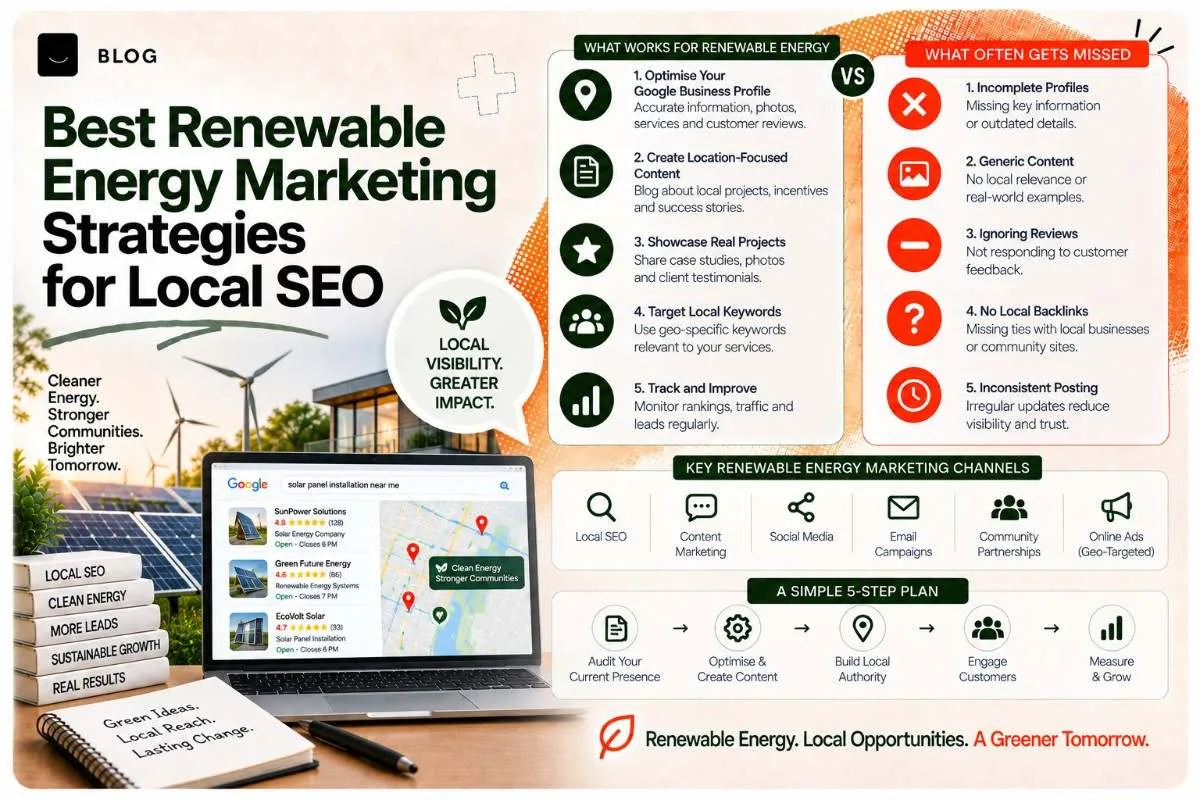
Best Renewable Energy Marketing Strategies for Local SEO
Solar and renewable energy marketing in India sits in an unusual position: real, growing demand, a genuine trust deficit the category has to overcome, and remarkably little competition for the specific, detailed content that actually resolves a buyer's hesitation. This is the full set of strategies that work together — not a single tactic, but how they connect, because the gap in most solar marketing is not any one weak point but the absence of a system tying them together.
Why solar marketing is unusually winnable right now
Worth stating plainly before the list, because it explains why this vertical deserves real investment rather than a token effort.
A solar buyer's decision involves genuine anxiety most categories do not have to overcome: a large upfront cost, unfamiliar technical claims, subsidy paperwork nobody explains clearly, and a wave of poor installations that has made the category's reputation shakier than the technology deserves. That anxiety is exactly what specific, honest, detailed content resolves — and very few installers are publishing it. Most solar websites are still one page of general claims.
The strategies below are not individually novel. What makes them work in this category specifically is that almost nobody is doing all of them together, and a buyer this cautious rewards a company that visibly has.
1. Local pages, done properly
Not one "Solar Installation Services" page. A page per city or region actually served, each stating real local detail — typical installation timelines in that area, any region-specific subsidy or discom process, local project examples, and genuine local contact information.
The test: could this page have been written for any city with the name swapped? If yes, it will not rank and will not be cited, because it carries no specific information a system or a reader can use.
2. Education content that answers the real objections
The content that moves a cautious buyer is not a sales page. It is a genuinely useful explanation of the thing they are anxious about: how net metering actually works in their state, what a typical installation timeline looks like start to finish, how to read a quotation and what makes one legitimate versus inflated, what happens if a panel underperforms, how maintenance actually works.
This content earns trust and, done well, earns citation in AI answers to the exact questions a hesitant buyer is asking an assistant right now.
3. A landing page built for the traffic you are paying for
If you run paid campaigns, the landing page determines whether that spend converts. Message match with the ad, a clear and specific offer, genuine trust elements — actual certifications, actual project photos, not stock imagery — and a form that asks only what you need to follow up.
This is detailed enough to warrant its own full guide, which exists separately in this library and is linked below. The point here is that a strategy list without this item is incomplete — the best content in the world does not convert if the page it lands on does not.
4. Reporting that proves the work is working
Solar companies frequently run marketing without ever seeing whether it produced qualified leads, because the reporting connecting search visibility to actual enquiries never gets built. This matters more in solar than most categories because the sales cycle is long enough that the connection between a blog post published in March and a lead in June is easy to lose.
A monthly report connecting visibility, traffic and actual leads — not vanity metrics — is what turns marketing from a cost nobody can justify into a system that can be improved deliberately. This is its own guide as well, linked below.
5. Reviews and Google Business Profile, kept current
A completed, accurate Google Business Profile matters more in solar than in most categories, because it is frequently the first thing a cautious buyer checks before anything else — genuine reviews, real project photos, and a complete profile are doing trust-building work that no amount of ad copy replaces.
This is covered at the operational level elsewhere in this library for a different vertical; the same discipline — complete attributes, accurate hours, replying to every review with specific detail — applies directly here.
6. Case studies with real, specific numbers
Client logos and vague testimonials do very little for a category built on scepticism. A proper case study — the client's actual situation, what was installed, and specific results with real numbers, published with permission — does far more, both for a human reader and for an AI system looking for something concrete to cite.
This is the single most underused asset in solar marketing. Most installers have the projects. Almost none have written them up properly.
7. Subsidy and incentive content, kept accurate
Subsidy schemes and incentive structures are exactly the kind of detail buyers search for and exactly the kind of content that goes stale fastest. A page explaining the current subsidy process, kept genuinely current rather than published once and forgotten, is high-value and high-risk in the same breath — valuable when accurate, actively harmful when it is not.
VERIFY: Do not publish any specific subsidy figure, scheme name or eligibility detail without verifying it against the current official scheme documentation on the day of publishing. This content needs a standing quarterly review commitment, not a one-time write-up — flag it for the refresh schedule the moment it is published.
8. Getting cited in AI answers, not just ranked
A buyer increasingly asks an AI assistant a question like "how does solar subsidy work in Madhya Pradesh" or "how do I know if a solar quote is fair" before ever visiting a company website. The content strategies above — genuine education content, specific local detail, real case studies — are exactly what gets an assistant to cite a specific installer rather than hedging or naming a generic explainer site.
This connects everything above into the broader GEO argument covered throughout this library: specific, verified, well-structured content wins in AI search the same way it wins in conventional search, and solar's trust deficit makes specificity an even stronger differentiator than in most categories.
How these fit together
The reason to think of these as a system rather than a checklist: local pages bring the right geographic traffic, education content resolves the anxiety that traffic arrives with, the landing page converts it, the case studies and reviews provide the proof that closes the remaining doubt, and the reporting tells you which of it is actually working so the next quarter's effort goes where it earns the most.
Miss any one piece and the others underperform. A brilliant education post with nowhere converting the traffic it earns. A converting landing page with no content bringing anyone to it. Reviews nobody sees because the profile is otherwise incomplete.
What to do first
If starting from close to nothing, in order:
- Complete the Google Business Profile properly. Cheapest, fastest, highest immediate trust impact.
- Write two or three genuine case studies from projects already completed. The raw material already exists.
- Build one proper local page for the primary service area, as a template for more.
- Write the education content answering the three questions asked most often on sales calls. That material is already being explained verbally; it just needs writing down.
- Fix the landing page, if paid campaigns are running.
- Set up basic reporting connecting visibility to actual leads.
Items 1 through 3 can genuinely be done in a week with existing material. Items 4 through 6 are where an ongoing programme becomes worthwhile.
Frequently asked questions
No single strategy works in isolation. The combination that performs best is complete, accurate local business profiles; genuine local landing pages per service area; education content answering real buyer objections; specific case studies with real numbers; and a landing page built to convert paid traffic — connected by reporting that shows which parts are actually working.
Solar buyers face a large upfront cost, unfamiliar technical claims, subsidy paperwork, and a category reputation affected by poor installations elsewhere. That combination creates genuine anxiety that generic marketing content does not resolve. Specific, honest, detailed content that addresses real objections performs unusually well because so few installers are publishing it.
Yes. Vague testimonials and client logos do little for a category built on scepticism. A proper case study with a client's actual situation, what was installed, and specific real numbers is far more persuasive to both readers and AI systems looking for something concrete to cite, and most installers already have the underlying projects to draw from.
On a standing quarterly review at minimum, and immediately whenever a scheme changes. Subsidy content is high-value when accurate and actively harmful when it goes stale, since a buyer acting on outdated eligibility information can face real financial consequences. No specific figure should be published without verification against current official documentation.
Yes, and this is becoming a meaningful part of the buyer journey. Specific, verified, well-structured content on questions like how subsidies work or how to evaluate a quotation is exactly what an AI assistant needs to cite a specific installer rather than a generic explainer site. Solar's trust deficit makes this specificity advantage stronger than in most categories.
Complete the Google Business Profile fully, write two or three case studies from already-completed projects, and build one properly detailed local landing page as a template. These can be done in roughly a week using material that already exists, before committing to an ongoing content programme.
Ready to build what's next?
Tell us where you're headed. We'll come back with a plan to get there.
Book an intro call