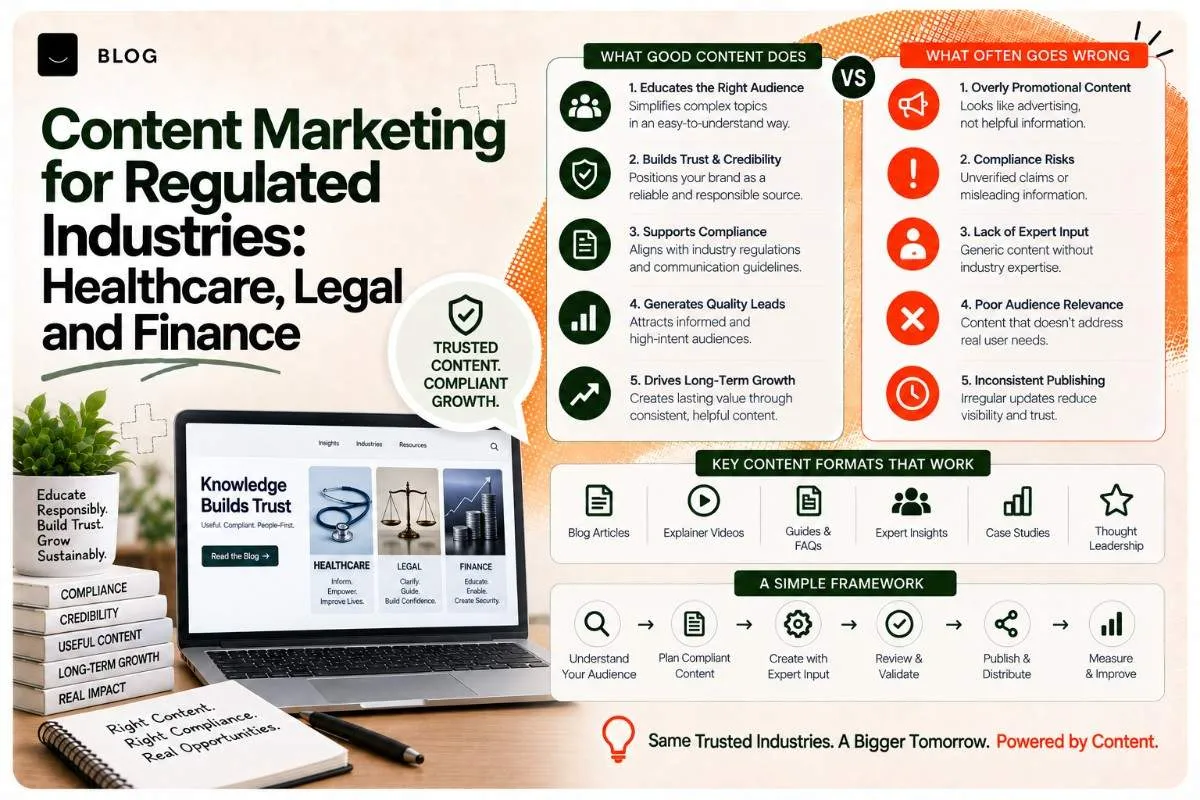
Content Marketing for Regulated Industries: Healthcare, Legal and Finance
In regulated sectors, content has to clear a compliance bar before it can earn anything. Most firms respond either by publishing nothing or by publishing generic material that carries no risk and no value. Neither is necessary. This post sets out an operating model for producing genuinely useful content in healthcare, legal and financial services — one that treats the constraints as a source of differentiation rather than an obstacle.
What this post is and is not
This is a description of a content operating model. It covers how to structure review, what to document, and how to publish usefully within constraints.
It is not a summary of anyone's regulatory obligations. Medical practitioners, advocates, financial advisers, insurers and lenders in India each operate under different regimes — professional conduct regulations, bar council rules, financial-sector regulator requirements — and those rules change. Nothing here should be read as telling you what your rules permit.
Firms must establish their own boundaries with qualified advice. The model below assumes you have done that. It does not substitute for it.
VERIFY: Before publishing, confirm that this post does not state or imply any specific regulatory requirement for any sector. If any passage reads as compliance guidance rather than as process description, rewrite it. Consider a lawyer's review of the framing.
Why regulated-industry content usually fails
Four failure patterns, and they are remarkably consistent across sectors.
Paralysis. Nobody is confident about what is permitted, so nothing gets published. Years pass. Meanwhile the firm is invisible to every patient, client or customer researching online.
Legal-review-as-bottleneck. Content is written, sent to a busy partner or compliance officer, and sits. The reviewer eventually returns it heavily marked or not at all. Marketing concludes the process does not work; compliance concludes marketing does not understand the constraints. Both are half right.
Sanitisation. Content survives review by having every specific removed. What publishes is technically compliant and useless — which is its own kind of failure, since it consumes budget and earns nothing.
Overreach. The opposite: content that makes claims nobody checked, published because it read well. This is the expensive failure, and it usually happens when review is treated as optional for "just a blog post."
The common cause is that review is bolted onto the end of a process designed without it.
The reframe: constraints are the differentiator
Here is the argument worth taking seriously.
The categories where regulated firms compete — health information, legal questions, financial decisions — are exactly the categories where the open web is worst. They are flooded with content produced by people with no accountability: aggregators, affiliate sites, content farms optimising for traffic on questions that materially affect people's lives.
A firm that publishes carefully, with a named credentialed author, verified claims and honest limitations, is producing something structurally different from most of what exists. That is not a compliance compromise. It is a competitive position that unregulated competitors cannot occupy, because they lack the credentials to make it credible.
The constraint that makes publishing slow is the same constraint that makes the output valuable.
The operating model
1. Write the boundary document first
Before any content is commissioned, produce a short internal document, agreed with whoever holds compliance responsibility, covering:
- What subjects may be discussed and at what depth
- What claim types are prohibited outright — guarantees, outcome promises, comparative superiority, specific results
- Required disclaimers, and where they go
- Who reviews what, and what their turnaround commitment is
- What is escalated beyond routine review
- How client, patient or customer information may and may not be referenced
Two pages. Written once, revisited annually or when rules change.
This document does more than any other single intervention, because it converts "check with legal" from an open-ended question into a defined test writers can apply themselves.
2. Separate the three content types
Not everything needs the same scrutiny, and treating it as though it does is what creates the bottleneck.
- Educational. General explanation of a condition, a legal concept, a financial instrument. Lowest risk, highest volume, usually the bulk of the programme.
- Procedural or firm-specific. How the firm works, what an engagement involves, what to expect. Moderate risk — this is where implied promises creep in.
- Advisory-adjacent. Anything approaching guidance on a specific situation. Highest risk, most valuable, and the category where most regimes draw their firmest lines.
Route each type through a different review depth. Sending educational content through the same process as advisory-adjacent content is why the queue never clears.
3. Build review into the workflow, not after it
Three changes that consistently unblock this:
- Brief the reviewer before writing, not after. A five-minute conversation about the angle prevents a rewrite.
- Review the outline, not the draft. Structural problems are cheap to fix at outline stage and expensive at draft stage.
- Batch reviews on a fixed schedule. A standing thirty-minute weekly slot beats ad-hoc requests that compete with billable work.
4. Keep an evidence file per piece
For every published piece, keep a short record of every factual claim, its source, who verified it, and when.
This does three things: it makes re-review fast when rules or facts change, it produces a defensible record if a claim is ever challenged, and it disciplines the writing, because a claim that cannot be sourced does not get made.
For a firm publishing regularly, this is the difference between a content library that is an asset and one that is a liability nobody has audited.
5. Set a re-review trigger
Regulated content ages differently. A rule changes and previously-compliant content becomes non-compliant while sitting quietly on your site.
Set explicit triggers: a scheduled annual review of every piece, plus an immediate review of affected content whenever a relevant rule changes. Assign the monitoring to a named person. "Someone will notice" is not a process.
What to publish when you cannot make claims
The most common objection is that constraints leave nothing to say. In practice the opposite is true — the constraints simply rule out the low-value content and leave the high-value content.
Explain things properly. What a condition actually is. What a legal process actually involves. How an instrument actually works. Done at genuine depth by a qualified person, this is more useful than most of what ranks.
Answer the questions people are embarrassed to ask. Every regulated professional knows the questions clients ask only once they trust you. Published plainly, these are enormously valuable and rarely covered.
Explain your process. What happens at a first consultation. What documents to bring. What the timeline looks like. What it will cost and what drives that. No claims required; high anxiety reduced.
Explain what you cannot do. Scope limits, when to go elsewhere, what falls outside your practice. Trust-building, differentiating, and entirely safe.
Correct common misconceptions. Every regulated field has widespread wrong beliefs. Correcting them is useful, citable and requires no promotional claim.
Document the process, not the outcome. Where results cannot be advertised, describing method and approach usually can be — subject to your boundary document.
Notice that none of these require a claim about superiority or results. That is the point.
The AI-search angle, and why regulated firms are well placed
Health, legal and financial questions are the categories where AI answer engines are most cautious about their sources — the stakes of a wrong answer are highest, and the systems are built accordingly.
That caution favours exactly the characteristics a regulated firm can supply and a content farm cannot: identifiable credentialed authorship, verifiable claims, cited sources, clear statements of limitation, and institutional accountability.
The practical implications:
- Name your authors, with credentials. In these fields it is the single strongest signal available. Add Person schema with qualifications.
- Cite primary sources — regulators, statutes, peer-reviewed research, official guidance. Regulated firms are better placed to do this than almost anyone.
- State limitations explicitly. The disclaimers compliance requires are, usefully, also the epistemic honesty these systems favour.
- Answer completely. Content that resolves a question rather than withholding to force a call.
There is a genuine tension in that last point — commercial instinct says withhold, and answering completely is what earns citation. That trade-off should be decided deliberately rather than by default.
Using AI tools in a regulated content workflow
Briefly, because the risk profile differs sharply from other sectors.
Reasonable: drafting educational explanation from verified source material, restructuring content, producing outlines, generating FAQ questions from real client queries, and rewriting technical language into plain language.
Not acceptable without verification by a qualified person: any factual claim, any regulatory statement, any statistic, any citation. Language models fabricate confident, plausible citations — including case references, study names and regulatory provisions that do not exist. In a regulated context that is not an embarrassment; it is a serious problem.
The rule: AI drafts the prose, a qualified person supplies and verifies every fact. Same discipline this library applies to technical specifications, applied where the stakes are higher.
Do not put confidential client, patient or customer information into a general-purpose AI tool. This should be in the boundary document.
Warning signs in an agency proposal
If you are hiring for this, these should give you pause:
- Guaranteed rankings or lead volumes in a regulated category
- No question about your compliance process in the first conversation
- A content calendar produced before anyone asked what you are permitted to say
- Case studies with named regulated clients and specific results, without evident consent
- Willingness to publish without a review step
- No mention of who verifies factual claims
- Proposed volume that could not plausibly be reviewed properly
The last one is the most common. A proposal for twenty posts a month in a regulated field is a proposal to skip review.
Frequently asked questions
Yes, and the constraints often produce better content than unregulated competitors publish. The requirement is an operating model that builds compliance review into the workflow rather than bolting it on afterwards, together with a documented set of boundaries agreed with whoever holds compliance responsibility.
Usually because review is treated as a final approval step rather than part of the process. Content is written, sent to a busy reviewer, and sits. Briefing reviewers before writing, reviewing outlines instead of drafts, and batching reviews on a fixed schedule resolves most of it.
Substantive explanation of conditions, processes or instruments; answers to the questions clients ask only after they trust you; a clear description of what an engagement involves; explicit statements of what the firm does not do; and corrections of common misconceptions. None require a claim about results or superiority.
Keep an evidence file for every published piece recording each claim, its source, who verified it and when. This makes re-review fast when rules or facts change, produces a defensible record if a claim is challenged, and disciplines the writing, because an unsourceable claim does not get made.
For drafting prose from verified material, restructuring, outlining and plain-language rewriting, yes. Not for generating factual claims, regulatory statements, statistics or citations — language models produce confident, plausible references that do not exist, which in a regulated context is a serious problem rather than an embarrassment. A qualified person must verify every fact.
It is well placed to. Health, legal and financial questions are where answer engines are most cautious about sources, which favours identifiable credentialed authorship, cited primary sources and explicit statements of limitation — all things a regulated firm can supply and a content farm cannot.
Whether they ask about your compliance process in the first conversation, who verifies factual claims, whether the proposed volume could plausibly be reviewed properly, and whether they guarantee outcomes. A proposal for high monthly volume in a regulated field is usually a proposal to skip review.
Ready to build what's next?
Tell us where you're headed. We'll come back with a plan to get there.
Book an intro call