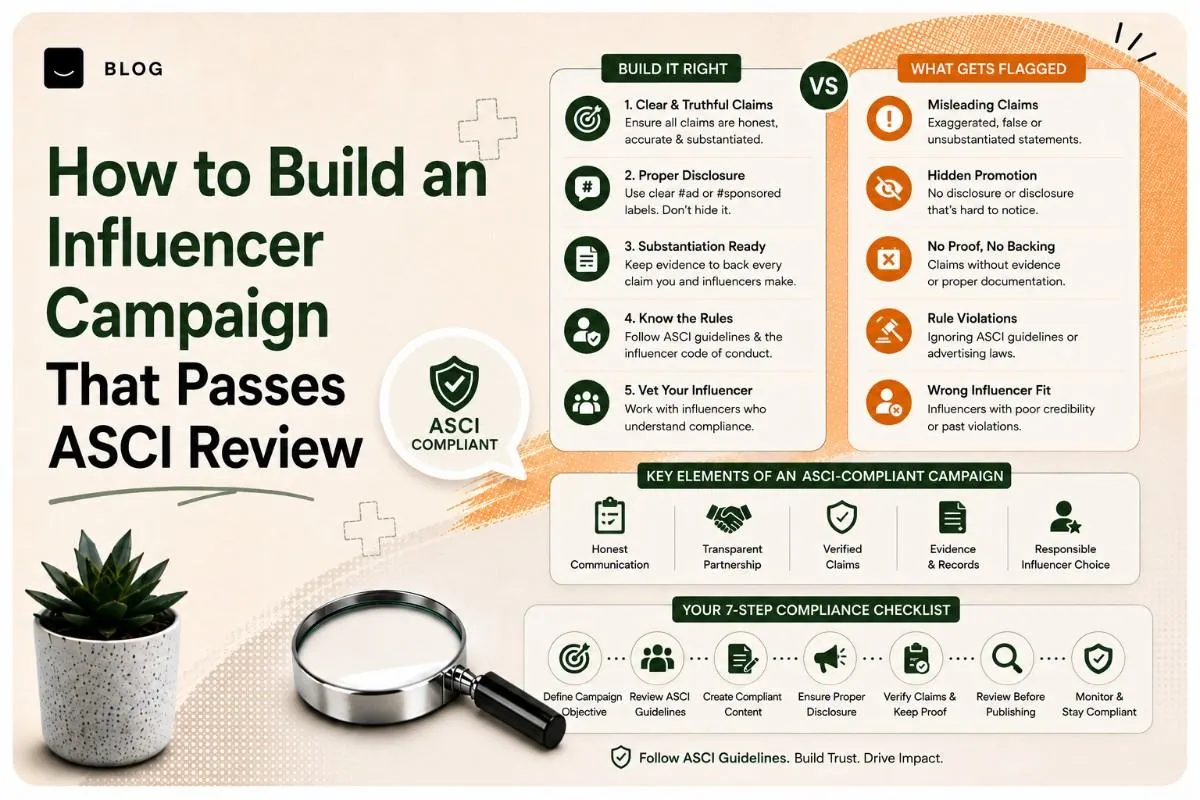
How to Build an Influencer Campaign That Passes ASCI Review
An influencer campaign passes ASCI review when every piece of paid or incentivised content carries a clear, upfront disclosure that the audience can't miss — and when that requirement is built into the brief and contract rather than added after the post goes live.
Most compliance failures in Indian influencer marketing aren't deliberate. They happen because disclosure was treated as the creator's problem, mentioned once in a WhatsApp message, and never checked before publication. This guide covers how to structure a campaign so that doesn't happen.
Important: this is a practical marketing guide, not legal advice. ASCI's guidelines are updated periodically, and enforcement interacts with consumer-protection law. Verify current requirements directly at ascionline.in and take qualified advice for anything high-stakes.
Who ASCI is, and why its guidelines carry weight
The Advertising Standards Council of India (ASCI) is a self-regulatory body for advertising in India. It issues the guidelines that govern how influencers and brands must disclose paid promotional content.
"Self-regulatory" sometimes gets misread as optional. It isn't, in practice. ASCI's influencer guidelines connect to India's broader consumer-protection framework, and the Central Consumer Protection Authority (CCPA) has statutory powers around misleading advertising and endorsement. A campaign that ignores disclosure isn't just risking a reprimand — it's exposing both brand and creator to real regulatory consequence, and to the reputational damage of being publicly flagged.
VERIFY: Before publishing, confirm ASCI's current influencer guideline version and any recent updates at ascionline.in. Do NOT add specific penalty amounts, enforcement statistics, or named case examples to this post without verifying them against a primary source — a great deal of inaccurate detail on this circulates.
What counts as a "material connection"
This is the concept everything else hangs on, and it's broader than most brands assume.
A material connection exists whenever the creator has received anything of value that could reasonably affect how the audience perceives their endorsement. That includes:
- Money — the obvious one
- Free products or services, including items sent unsolicited that the creator then features
- Barter arrangements — content in exchange for goods
- Discounts or exclusive access not available to the public
- Affiliate commission or revenue share on sales
- Trips, event invitations, hospitality
- Family or employment relationships with the brand
The last two catch people out constantly. A gifted product with no payment still requires disclosure. An employee posting about their own employer's product requires disclosure. "We didn't pay them" is not a defence.
The disclosure rules in practice
It must be upfront and hard to miss
Disclosure has to be prominent — visible without the audience having to work for it. That means:
- Not buried in a wall of hashtags at the end of a caption
- Not hidden behind a "more" link that requires a tap to expand
- At the start of the caption or description, where it's seen before the content is consumed
- Clearly legible — adequate size and contrast if it's an overlay
The test to apply: would an average scrolling user notice this before forming an impression? If the answer needs an argument, it isn't prominent enough.
It must be in a language the audience understands
Disclosure must be understandable to the audience actually being addressed. For a creator posting in Hindi, Tamil or a mixed language, an English-only disclosure label may not meet the standard for that audience.
This is frequently ignored in Indian campaigns and it's a genuine risk area. Match the disclosure language to the content language.
Video and audio need their own treatment
A text disclosure in a video description doesn't cover a viewer who watches without reading it.
For video, disclosure should be visible on screen for long enough to actually read, placed where it won't be cropped by the platform's UI. For live streams and audio content, it needs to be stated aloud, and repeated periodically for longer content rather than mentioned once at the start.
ASCI has moved toward stricter expectations here over time.
VERIFY: Confirm current video/audio-specific requirements — this is an area that has been updated.
Platform tools alone may not be enough
Instagram's "Paid partnership" label and YouTube's paid-promotion toggle are useful, and you should use them. But treating them as sufficient on their own is risky — placement, visibility and persistence vary by platform and surface.
The safe approach: use the platform tool and include a clear written or spoken disclosure in the content itself. Redundancy costs nothing.
Who is actually liable — brand or creator?
Both. This is the part brands most often get wrong.
Advertisers carry responsibility for the advertising they commission, and creators carry responsibility for what they publish. A brand cannot outsource compliance by putting it in a contract and looking away, and a creator cannot claim the brand never told them.
Practically, this means the brand or agency must verify compliance rather than merely require it. Requiring disclosure in a contract and never checking the live post is the single most common structural failure in Indian influencer campaigns.
Building compliance into the campaign, not bolting it on
Compliance fails when it's an afterthought. Build it into the workflow at four points:
- In the brief. State the exact disclosure wording, where it must appear, in which language, and for how long it must be visible on video. Don't write "please disclose" — write the specific requirement, with an example.
- In the contract. Make disclosure a contractual deliverable, not a request. Include the right to require correction, and to withhold payment until the content is compliant.
- In the approval step. Review the content before it goes live. This is where most problems are cheapest to fix. Check the disclosure is present, prominent, in the right language, and correctly placed.
- In post-publication verification. Check the live post on the actual platform, on mobile, as an ordinary user would see it. Content can look compliant in a preview and get truncated or cropped in the live feed.
Document each step. If a campaign is ever questioned, evidence that you specified, contracted, reviewed and verified is materially better than good intentions.
The pre-launch compliance checklist
- Every creator with any material connection is identified — including gifted-product and affiliate arrangements
- Disclosure wording is specified in the brief, with an example
- Disclosure is contractually required, with a correction right
- Disclosure language matches the content language
- Placement is upfront, not buried in hashtags or behind "more"
- Video disclosures are on-screen, legible, and long enough to read
- Audio and live content include a spoken disclosure, repeated for long formats
- Platform disclosure tools are enabled in addition to in-content disclosure
- Claims made about the product are substantiated — disclosure doesn't legitimise a false claim
- Content is reviewed before publishing
- Live posts are verified on mobile after publishing
- Records of briefs, approvals and verification are retained
Special cases worth extra care
Health, wellness and supplements. Endorsement claims in health-adjacent categories attract additional scrutiny, and unsubstantiated health claims are a separate problem from disclosure. Take specialist advice.
Financial products and investment content. Heavily regulated, with obligations beyond ASCI's remit. Do not treat a disclosure label as sufficient.
Children and young audiences. Content aimed at or likely to reach minors carries additional expectations.
AI-generated influencers and virtual personas. A growing area where the audience may not realise they're not seeing a real person. Disclosure expectations here have been evolving — verify the current position before running such a campaign.
Unsolicited gifting. If a creator receives a product unprompted and posts about it, a material connection still exists. Brands running seeding programmes should communicate disclosure expectations when the product ships, not after a post appears.
What to do if something goes wrong
If non-compliant content is already live:
- Fix it immediately — add the disclosure, or take the content down while it's corrected.
- Document what happened and what you did. Prompt, evidenced correction matters.
- Find out where the process failed — brief, contract, review, or verification — and close that gap for the next campaign.
- Take qualified advice if the campaign is large, the category is regulated, or you've been contacted by a regulator.
Don't quietly delete and pretend it didn't happen, particularly if the content had reach. Correction handled visibly is better than concealment discovered later.
Conclusion
Disclosure isn't the enemy of good influencer marketing. Audiences in India are broadly accustomed to sponsored content, and clear labelling costs far less trust than being caught concealing it. The campaigns that get into trouble are almost never the ones that disclosed clearly — they're the ones that treated compliance as someone else's job.
Want influencer campaigns run with compliance built into the process from the brief onward?
Contact Crescent for a free consultation.
Frequently asked questions
A material connection exists whenever a creator has received anything of value that could reasonably affect how the audience perceives their endorsement. This includes money, free products, barter arrangements, exclusive discounts, affiliate commission, trips and hospitality, and family or employment relationships with the brand.
Yes. A free product creates a material connection whether or not money changed hands, and content featuring it requires disclosure. This applies to unsolicited gifting as well, so brands running seeding programmes should communicate disclosure expectations when the product ships.
Platform disclosure tools are useful and should be used, but relying on them alone is risky because their placement, visibility and persistence vary across platforms and surfaces. The safer approach is to use the platform tool together with a clear written or spoken disclosure within the content itself.
Both. Advertisers carry responsibility for advertising they commission and creators for what they publish. A brand cannot outsource compliance by putting it in a contract and not checking, so the brand or agency should verify live content rather than only requiring disclosure.
A text disclosure in a video description does not cover viewers who never read it. Video disclosures should appear on screen, legibly, long enough to be read and positioned where platform interface elements will not crop them. Live and audio content should include a spoken disclosure, repeated periodically in longer formats.
Ready to build what's next?
Tell us where you're headed. We'll come back with a plan to get there.
Book an intro call