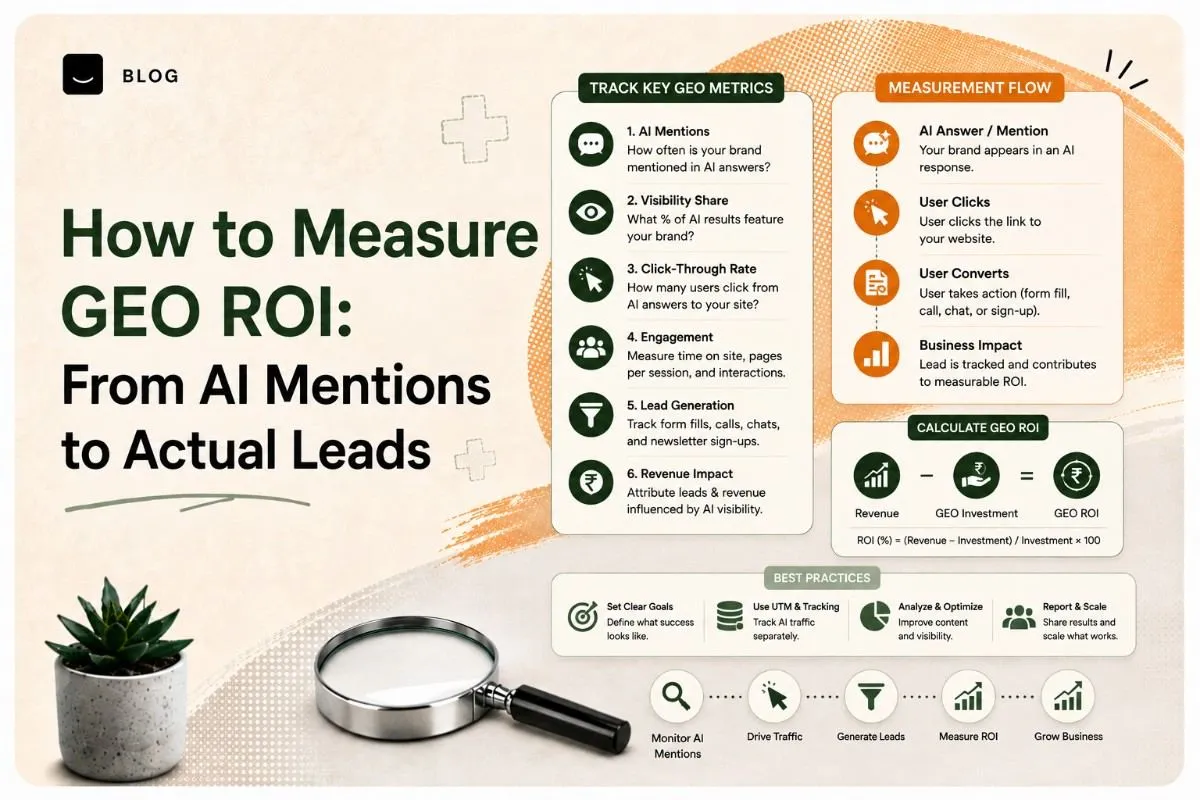
How to Measure GEO ROI: From AI Mentions to Actual Leads
Measuring GEO ROI means connecting AI citations to business outcomes across four layers: whether AI engines name you, whether that produces clicks, whether it lifts branded search, and whether any of it becomes leads and revenue.
No single metric captures it, which is exactly why most businesses either skip measurement entirely or declare victory on a screenshot of ChatGPT mentioning them.
Generative engine optimization is real work with real cost. It deserves real measurement — and it's measurable, provided you accept that the most important outcome often produces no click at all.
Terminology: GEO here means Generative Engine Optimization — being cited by AI answer engines. Not geographic SEO.
Why GEO ROI is hard to measure
Three structural problems make this harder than measuring SEO.
The win often has no click. An AI names your business, answers the question, and the user acts — or doesn't — without ever visiting your site. Your analytics see nothing.
That's not a failure of GEO; it's a failure of click-based measurement to capture it.
There's no rank tracker for AI answers. Search rankings are stable enough to track daily. AI answers vary by phrasing, by user, by session, and change as models update. There's no single "position" to record.
Attribution breaks down. A patient hears your clinic name from ChatGPT, thinks about it for a week, then searches your name directly and calls. Analytics records that as branded organic search.
The AI got the credit for nothing, and your GEO work looks like it did nothing.
The answer isn't to give up on measurement. It's to measure the layers you can see, and use sensible proxies for the layer you can't.
The four-layer GEO measurement model
| Layer | Question it answers | How you measure it |
|---|---|---|
| 1. Citation share | Are AI engines naming us? | Manual prompt testing, or a GEO tracking tool |
| 2. Referral traffic | Is it producing clicks? | GA4 referral segments |
| 3. Branded search lift | Is awareness rising? | Search Console branded impressions |
| 4. Leads and revenue | Is it making money? | CRM, call tracking, form source questions |
Work through them in order. Layer 1 is where GEO succeeds or fails; layers 2–4 tell you what that success is worth.
Layer 1: Citation share — are you being named?
This is the core GEO metric, and it's the one no standard analytics tool gives you. You have to go and look.
The manual method (free, and worth doing even if you buy a tool):
- Write a fixed list of 15–25 questions your customers actually ask — the same prompts every time, so results are comparable month to month.
- Ask each one in ChatGPT, Perplexity, Gemini, and check Google for an AI Overview. Use a fresh session each time.
- Record for each: cited (named with a link or clear attribution), mentioned (named, no attribution), absent, or inaccurate.
- Calculate your citation share — the percentage of your prompt set where you appear at all.
- Record which competitors appear where you don't.
- keeping cited content current
Run this monthly, on the same prompt list. The absolute number matters less than the trend. Going from 2/20 to 7/20 over four months is unambiguous progress.
Tools such as Semrush's AI visibility features, Ahrefs Brand Radar, Profound, Otterly and others automate this at scale.
They're worth it once you're tracking many prompts or multiple locations. Start manual — it also teaches you why you're missing, which a dashboard won't.
Layer 2: Referral traffic — is anyone clicking through?
When an AI answer includes a link and someone clicks it, that arrives in your analytics as referral traffic.
This is a minority of GEO's value, but it's the part you can count precisely.
Setting up AI referral tracking in GA4
You don't need custom code. In GA4:
- Go to Reports → Acquisition → Traffic acquisition.
- Change the dimension to Session source / medium.
- Search for the AI domains — chatgpt.com, perplexity.ai, gemini.google.com, copilot.microsoft.com, and any others relevant to your market.
- Save this as a comparison or custom segment so you can pull it monthly without rebuilding it.
- For a cleaner view, create an exploration with that segment applied, and add conversions as a metric so you can see not just visits but what they did.
Watch two things: the volume of AI referral sessions and, more interestingly, how those visitors behave compared to general organic traffic.
AI-referred visitors have often already been given an answer and a recommendation before they arrive, so they tend to be further along in their decision.
Compare engagement and conversion rate between the two segments in your own data rather than relying on published benchmarks. You can simply check this on Google Analytics Help on traffic sources
What Search Console does and doesn't show you
Search Console reports Google Search performance, and impressions from pages that appeared alongside AI Overviews are included in your normal Search data — but Google does not break out AI Overview appearances as a separate, isolated metric you can filter cleanly.
What that means practically: don't expect Search Console to tell you "you appeared in X AI Overviews."
Use it instead for Layer 3 — the branded search signal below — which is where it genuinely earns its place in GEO reporting.
Layer 3: Branded search lift — the zero-click proxy
This is the most under-used GEO metric, and often the most honest one.
When an AI recommends your business without a link, the interested user's next move is usually to search your name.
That shows up in Search Console as rising branded impressions and clicks — queries containing your business name.
To track it:
- In Search Console, open Performance → Search results.
- Add a Query filter containing your brand name and common misspellings.
- Record monthly impressions and clicks for that filtered set.
- Compare the trend against your GEO activity timeline.
Rising branded search with no matching increase in ads or PR is a strong indicator that something is putting your name in front of people — and in 2026, AI answers are increasingly that something.
It's a proxy, not proof. But it's the best available read on zero-click value, and it's free.
Layer 4: Leads and revenue — closing the loop
The layer that decides whether any of this was worth doing.
Ask directly. Add "How did you hear about us?" to every enquiry form and have reception ask it on calls.
Include an explicit option like "ChatGPT / AI assistant." This single question does more for GEO attribution than any analytics configuration, because it captures the zero-click journeys nothing else can see.
Tag what you can. AI referral sessions that convert should be visible in GA4 if your conversion events are set up. Connect that segment to your lead events.
Track the trend, not the transaction. GEO's contribution is usually diffuse — it raises the odds you're on the shortlist.
Look at total qualified enquiries over quarters against your citation share trend, rather than trying to attribute individual deals.
Building a simple GEO reporting dashboard
A monthly one-page report with six numbers is enough for most businesses:
- Citation share — appearances ÷ prompts tested
- Cited vs mentioned split — how many included attribution
- Inaccuracy count — where AI describes you wrongly (fix these first)
- AI referral sessions — from the GA4 segment
- Branded impressions — from the Search Console filter
- Enquiries citing AI — from your "how did you hear about us" data
Track them on the same dates every month as a citation share as a KPI. Six consistent numbers beat a sophisticated dashboard nobody updates.
What "good" looks like in the first six months
Set expectations honestly, because GEO is slower than paid and roughly comparable to SEO in pace.
- Months 1–2: citation share barely moves. You're publishing and fixing entity signals. The main visible win is correcting inaccuracies.
- Months 3–4: first citations appear, usually on your most specific and least competitive questions.
- Months 5–6: citation share climbs measurably; branded impressions begin trending up; the first enquiries mention an AI assistant.
If citation share is completely flat at month four with real publishing behind it, the problem is usually content structure — answers buried too deep, or entity signals still inconsistent — not the strategy.
The mistake most businesses make
Measuring GEO purely in traffic.
If you judge GEO by sessions, you'll conclude it doesn't work — because its biggest wins are invisible to session-based analytics by design.
A business named in a hundred AI answers with no links has genuinely gained something: shortlist presence, brand recall, and the credibility of the engine's recommendation. Counting only clicks would score that as zero.
Measure citations and branded lift alongside traffic, and the picture becomes accurate.
GEO is measurable — just not with the same instruments as SEO. Track whether you're named, whether it produces clicks, whether your name is being searched more, and whether enquiries mention it. Four layers, six numbers, once a month.
Want a GEO measurement framework set up for your business, with the tracking configured properly?
Contact Crescent for a free consultation For SEO, AEO and GEO
Frequently asked questions
Measure GEO ROI across four layers: citation share, referral traffic, branded search lift, and leads or revenue. Citation share measures whether AI engines name you. Referral traffic tracks clicks from AI answers in GA4. Branded search lift measures rising brand queries in Search Console as a proxy for zero-click value. Leads and revenue are captured through CRM, conversion tracking, and asking enquirers how they heard about you.
In GA4, open Reports, then Acquisition, then Traffic acquisition, change the dimension to Session source / medium, and filter for AI domains such as chatgpt.com, perplexity.ai and gemini.google.com. Save this as a segment or comparison so it can be pulled monthly, and add conversion metrics to see what those visitors do.
Citation share is the percentage of a fixed set of test prompts where an AI answer engine names your business. It is measured by asking the same list of customer questions in ChatGPT, Perplexity, Gemini and Google each month and recording whether you were cited, merely mentioned, absent, or described inaccurately.
Search Console includes performance from pages appearing alongside AI Overviews within its normal Search data, but does not break out AI Overview appearances as a separate metric you can isolate. It is more useful for GEO as a way to track branded impressions and clicks, which act as a proxy for zero-click AI visibility.
Citation share typically barely moves in the first two months while content is published and entity signals are corrected. First citations usually appear around months three to four on the most specific questions, with measurable citation share growth and rising branded impressions by months five to six.
Ready to build what's next?
Tell us where you're headed. We'll come back with a plan to get there.
Book an intro call