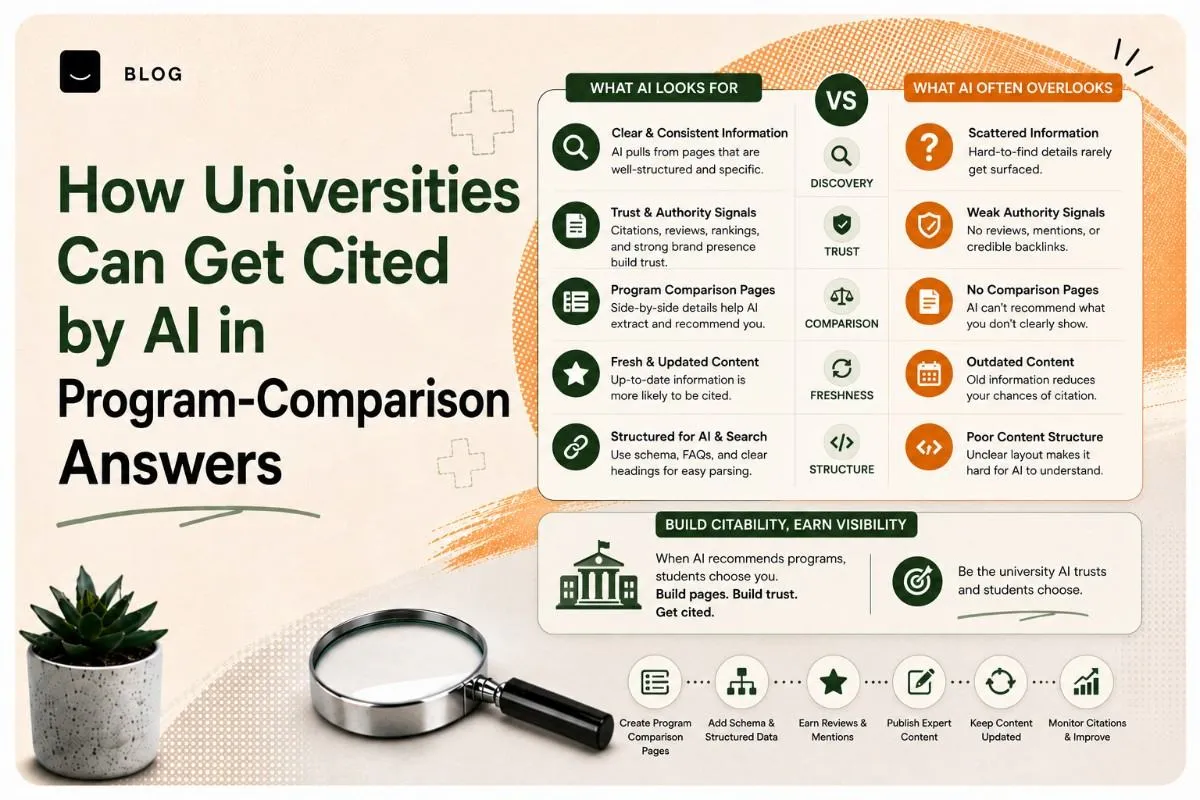
How Universities Can Get Cited by AI in Program-Comparison Answers
When a student asks ChatGPT "which colleges in India offer a good MBA in analytics under ₹10 lakhs?", the AI builds an answer from whatever it can read and trust. Universities whose program pages state fees, duration, eligibility and outcomes in plain, extractable text get named.
Universities whose details sit inside a downloadable prospectus PDF usually don't.
That's the whole problem in one sentence, and it's unusually fixable. Most institutions are losing AI visibility not because they lack authority — universities have plenty — but because their information is structured in a way machines can't use.
Terminology: GEO here means Generative Engine Optimization — being cited by AI answer engines. Not geographic SEO.
How students actually research courses now
The course discovery journey has changed shape. A prospective student typically starts broad and conversational — "best colleges for data science in India", "is an MBA worth it for someone with 3 years experience", "which universities accept my entrance score" — and increasingly asks an AI assistant rather than opening ten browser tabs.
The AI produces a shortlist. The student then verifies the shortlisted institutions directly.
Note what this means: the AI answer decides who gets considered, and your website's job shifts to confirming a decision that has already been narrowed. If you're not in the shortlist, the quality of your website barely matters.
Parents are part of this too, and often the ones running the comparison — frequently in a regional language.
Why most university websites lose the AI comparison
The information is in a PDF
The single biggest cause. Fees, curriculum, eligibility, placement data, and admission timelines all live inside a prospectus PDF or an image-based brochure.
That content is effectively invisible for comparison purposes. An AI can't pull your fee structure out of a scanned brochure to answer a fee question, so it uses an institution that published theirs as text — or a third-party aggregator that transcribed yours.
The page sells instead of informing
Many program pages read as marketing copy: "world-class faculty", "industry-aligned curriculum", "transformative learning experience". None of that is comparable.
An AI asked to compare three programs needs facts it can line up side by side — duration, fees, eligibility, specialisations, outcomes. Adjectives don't survive comparison.
Key facts are scattered across the site
Fees on one page, eligibility on another, curriculum in a PDF, placement statistics in a news post from two years ago.
Even when everything technically exists, a model assembling an answer favours a single page that has it all together over five pages that each have a fragment.
What an AI needs to compare your program
For a program to appear in a comparison answer, these facts need to exist as plain text, ideally on one page:
- Program name and level — exact, official, and consistent everywhere
- Duration and mode — full-time, part-time, online, hybrid
- Fees — total and per-year, stated clearly
- Eligibility — qualifications, entrance exams accepted, cut-offs where applicable
- Curriculum structure — core subjects, specialisations, electives
- Intake and application dates
- Outcomes — placement information, typical roles, further study paths
- Location and campus
How to restructure a program page for AI comparison
Six changes, in order of impact:
- Move every key fact out of the PDF and onto the page as text. Keep the PDF as a supplementary download, not the primary source.
- Put a factual summary block near the top — duration, fees, eligibility, intake — before the marketing narrative. This is the block an AI is most likely to extract.
- Use question-phrased subheadings that match how students ask: "Who is eligible for this program?", "What does this program cost?", "What jobs does this program lead to?"
- Answer each question in the first two sentences under its heading, then elaborate.
- Add Course and EducationalOrganization schema so the structure is machine-explicit rather than inferred.
- Keep it current and dated. Show when fees and intake information were last updated. AI answers favour content that is demonstrably current, and stale fee data is worse than none.
The comparison content universities avoid publishing
Here's the uncomfortable opportunity. Students search comparisons constantly — "MBA vs PGDM", "BTech CSE vs BTech AI", "online MBA vs executive MBA", "this university vs that one".
Universities almost never publish comparison content, because it feels like acknowledging alternatives.
The result: aggregator sites and coaching portals own all of it, and they get cited in AI answers about your programs.
Their descriptions of your institution — sometimes outdated, sometimes wrong — become the source.
You don't need to compare yourself against named rival institutions to fix this. Publish the category comparisons honestly instead:
- MBA vs PGDM — what actually differs, and who each suits
- Full-time vs executive vs online formats
- Your specialisations compared against each other
- Which entrance exams your programs accept, and what each requires
This is genuinely useful to a confused student, it's honest, and it puts your institution's voice into exactly the comparison queries that currently belong to third parties.
Answering the questions prospectuses skip
Admissions teams answer the same questions by phone and email all year and rarely publish the answers. These are precisely what students ask AI:
- What's the total cost including hostel, mess and other fees?
- Are scholarships available, and what are the criteria?
- Is there an education loan tie-up?
- What's the actual placement picture for this program, not the university overall?
- Can I transfer credits or change specialisation later?
- What's the hostel and campus situation for outstation students?
- Is the degree recognised for further study abroad?
Publishing clear answers to these does two jobs: it reduces repetitive admissions-office workload, and it creates exactly the extractable, factual content that AI answers draw on.
Third-party presence still decides a lot
Even with perfect pages, AI answers about education lean heavily on third-party sources — accreditation bodies, ranking listings, education portals and news coverage. Two things follow.
Keep third-party listings accurate. Wherever your institution appears on education portals and directories, the details should be current and match your own site.
Inconsistency between your page and a high-authority aggregator tends to resolve in the aggregator's favour.
Accreditation and recognition should be stated plainly on your own pages, in text, with the specifics. It's a trust signal for students and a factual anchor for models.
A practical checklist for admissions teams
- Pick your five highest-intake programs and rebuild those pages first.
- Move fees, eligibility, duration and curriculum out of PDFs into on-page text.
- Add a factual summary block at the top of each program page.
- Rewrite subheadings as student questions, answered directly.
- Publish an FAQ covering total cost, scholarships, loans, hostel and recognition.
- Add Course and EducationalOrganization schema.
- Publish two or three honest category comparisons (format vs format, qualification vs qualification).
- Audit third-party listings for accuracy and consistency.
- Test it: ask ChatGPT, Perplexity and Gemini the comparison questions a student would ask, and record whether you appear.
- Update fees and intake dates every cycle, with a visible last-updated date.
Want your program pages structured to appear in AI comparison answers?
Contact Crescent for a free consultation.
Frequently asked questions
Most commonly because key facts such as fees, eligibility and curriculum are locked inside prospectus PDFs or images that AI systems cannot read, because program pages use marketing language instead of comparable facts, or because the information is scattered across several pages rather than consolidated on one.
Program name and level, duration and study mode, total and per-year fees, eligibility including accepted entrance exams, curriculum structure and specialisations, intake and application dates, outcomes such as placements and typical roles, and campus location — all stated as plain text, ideally on a single page.
Yes, in category form rather than against named rival institutions. Publishing honest comparisons such as MBA versus PGDM, or full-time versus executive versus online formats, is genuinely useful to students and reclaims comparison queries that are currently answered by third-party aggregator sites.
Yes, when the PDF is the only place key facts exist. Fees, eligibility and curriculum inside a downloadable or image-based prospectus are effectively invisible for comparison purposes, so AI answers use institutions that published the same details as on-page text, or third-party sites that transcribed them.
Course schema for individual programs and EducationalOrganization schema for the institution, alongside FAQ schema on question-and-answer sections. This makes the structure explicit to machines rather than leaving it to be inferred from page layout. Universities aren't losing AI visibility because they lack credibility. They're losing it because the facts a machine needs are locked inside PDFs and buried under marketing language. Publishing them plainly is unglamorous work with a disproportionate payoff — and most institutions haven't started.
Ready to build what's next?
Tell us where you're headed. We'll come back with a plan to get there.
Book an intro call