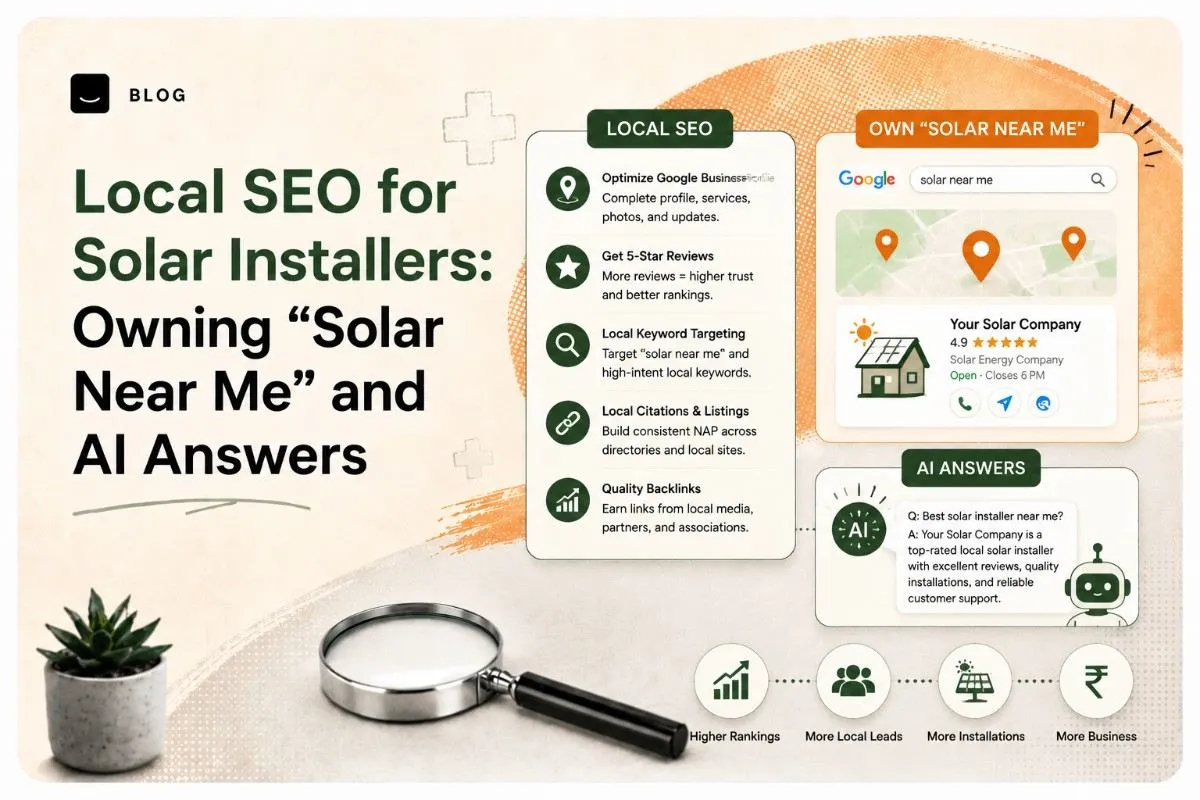
Local SEO for Solar Installers: Owning "Solar Near Me" and AI Answers
Local SEO for solar installers is the work of showing up when someone nearby searches for solar — in Google's map pack, in "solar near me" results, and increasingly inside AI answers. For most installers it's the single highest-return marketing channel, because solar buyers search with strong local intent and are usually ready to get quotes.
A homeowner searching "solar panel installation near me" isn't browsing. They're close to a decision. Solar company SEO is about making sure that when that search happens in your service area, you're the name they see first — and the name their AI assistant recommends.
Why local SEO is the highest-return channel for solar installers
Solar is a local, high-consideration, high-value purchase. That combination is almost tailor-made for local search.
The buyer wants an installer who serves their area, has real reviews, and can come out for a site visit. Those are exactly the signals local SEO rewards. And because a single installation is worth a substantial amount, even a modest lift in local visibility can return far more than it costs — often more reliably than paid ads, where every solar click is expensive and competitive.
Paid ads stop the moment you stop paying. A strong local presence keeps generating enquiries month after month. Most installers should treat local SEO as the foundation and paid as the accelerant — not the other way round.
What "solar near me" searchers actually want
Understanding the intent behind the search tells you what your pages need to say.
A "solar near me" searcher typically wants to know four things fast: do you serve my area, are you trustworthy, roughly what will it cost, and how do I get a quote. A page that answers those quickly will out-convert a prettier page that makes them hunt for the information.
They're also comparison shopping. They'll open three or four installers in tabs. The one that answers their questions clearly and shows recent, genuine reviews usually wins the call — not necessarily the one with the flashiest site.
Your Google Business Profile is the foundation
For a local solar business, your Google Business Profile often does more heavy lifting than your website. It's what feeds the map pack — the block of local businesses shown above the regular results — and it's frequently the first thing a buyer sees.
Get the fundamentals right:
- Complete every field. Business name, precise service categories, service areas, hours, phone, and a real description. Completeness is a genuine ranking signal.
- Choose accurate categories. "Solar energy company", "solar energy contractor" and related categories tell Google exactly what you do — pick the ones that match.
- Add real photos. Actual installs, your team, your vehicles. Not stock imagery.
- List your service areas honestly. Cover the towns and regions you genuinely serve, not an unrealistic radius.
- Post regularly. Updates, completed projects, and offers signal an active, current business.
Build local pages that actually rank
One generic "we install solar" page won't rank across every town you serve. Installers who win local search build dedicated pages for their key services and locations.
- Service pages: residential solar, commercial solar, battery storage, maintenance — each as its own page with real depth, not a paragraph.
- Location pages: a genuine, useful page for each major area you serve, describing your work there — not thin, duplicated templates with only the town name swapped, which Google and AI models both discount.
- Answer the buyer's real questions on the page: cost ranges, subsidy and incentive guidance, timelines, warranties. This does double duty — it converts human readers and gives AI answer engines something specific to cite.
Reviews: the fuel for solar local ranking
For a local solar business, reviews are close to the deciding factor — both for ranking and for the buyer's trust. A steady stream of recent, detailed reviews signals to Google that you're active and credible, and signals to a nervous buyer spending a large sum that other people in their area trusted you.
Build a simple system: ask every satisfied customer at the moment the install is done and they're happiest, make it effortless with a direct link, and respond to every review — positive or negative — professionally. Recency and velocity matter, so a slow, steady flow beats a burst of reviews followed by silence.
The new layer: getting cited in AI answers
Here's what most solar installers haven't caught yet. Buyers are starting to ask AI assistants — ChatGPT, Perplexity, Google's AI Overviews — questions like "who are the best solar installers near me?" or "how much does rooftop solar cost in my city?" The installers named in those answers get the enquiry. This is GEO — Generative Engine Optimization (being cited by generative AI, not geographic SEO).
The encouraging part: the work that wins AI citations overlaps heavily with good local SEO. Clear pages that answer real questions, consistent business information across the web, genuine reviews, and fresh content all help an AI model understand and trust you. A few solar-specific moves:
- Publish clear, factual answer content on cost, incentives, timelines and warranties — the exact things buyers ask AI.
- Keep your business details identical everywhere — your site, Google Business Profile, and every directory — so the model is confident about who and where you are.
- Update your key pages regularly. AI answers favour current information, and solar pricing and incentives change.
Most of your competitors aren't doing this yet. That's the opening.
A 30-day local SEO checklist for solar installers
A realistic first month:
- Week 1 — Fully complete and optimise your Google Business Profile: categories, service areas, photos, description.
- Week 1 — Audit your business name, address and phone across every directory and fix any inconsistencies.
- Week 2 — Build or rewrite your core service pages (residential, commercial, storage) with real depth and clear answers.
- Week 2 — Create genuine location pages for your top service areas.
- Week 3 — Set up a review-request system and start asking every completed customer.
- Week 3 — Add an FAQ answering cost, incentives, timelines and warranties (verify all figures against official sources).
- Week 4 — Run an AI visibility check: ask ChatGPT, Perplexity and Gemini the questions your buyers ask, and note where you're missing.
- Ongoing — Post to your Google Business Profile, gather reviews, and refresh pages on a regular cycle.
Want a local SEO and AI-visibility plan built specifically for your solar business?
Contact Crescent for a free consultation.
Frequently asked questions
Local SEO for solar installers is the work of making a solar company show up when nearby customers search for solar — in Google's map pack, in "solar near me" results, and increasingly in AI answers. It combines Google Business Profile optimisation, local service and location pages, and genuine customer reviews.
Solar companies rank higher locally by fully completing and maintaining their Google Business Profile with accurate categories and service areas, building genuine service and location pages that answer buyer questions, and earning a steady flow of recent, detailed customer reviews. Consistent business information across the web reinforces all of this.
For most installers, local SEO is the stronger foundation because it keeps generating enquiries month after month, while paid ads stop the moment spending stops and solar clicks are expensive and competitive. Many installers use local SEO as the foundation and paid ads as an accelerant rather than the main channel.
By publishing clear, factual answer content on cost, incentives, timelines and warranties, keeping business details consistent everywhere online, earning genuine reviews, and updating key pages regularly. This is generative engine optimization — being cited by AI answer engines — and it overlaps closely with strong local SEO.
There is no fixed number. What matters most is a steady, ongoing flow of recent, detailed, genuine reviews rather than a single burst, because recency and velocity signal an active, credible business to both Google and prospective buyers. Solar buyers search local and buy local. Local SEO puts you in front of them at the exact moment they're ready — and the same work increasingly earns you the AI citations your competitors haven't noticed yet.
Ready to build what's next?
Tell us where you're headed. We'll come back with a plan to get there.
Book an intro call