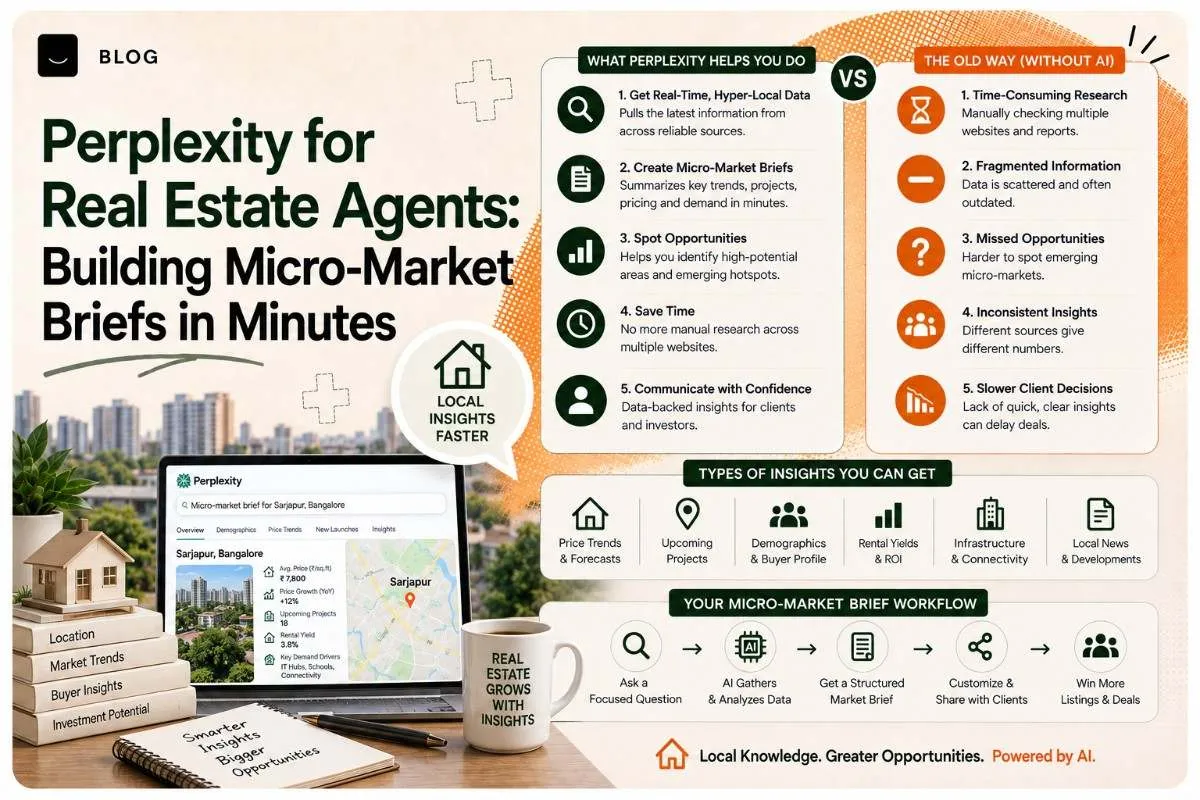
Perplexity for Real Estate Agents: Building Micro-Market Briefs in Minutes
A micro-market brief is a short, factual summary of a specific locality — connectivity, infrastructure, schools and hospitals, supply activity, and honest drawbacks — that helps a buyer decide whether an area is worth visiting. Perplexity is well suited to assembling the first draft of one because it cites its sources, which makes verification fast. The rule that makes this work in practice: the citations are a starting point for checking, not a substitute for it.
The problem this solves
Every serious buyer asks the same underlying question, whatever words they use: what is it actually like to live there?
Answering it well takes an agent hours. Metro extension timelines, which schools are within a realistic commute, whether the water situation is as bad as the WhatsApp group says, what is being built two streets over and what that will do to traffic. Most agents answer from accumulated knowledge, which is genuinely valuable but uneven — sharp on the three localities they work in constantly, thin on the fourth one a client just asked about.
The result is that briefs either take a long time or do not get made. Buyers get a WhatsApp message and a listing link instead.
Why Perplexity specifically, and not ChatGPT
For this particular task, the citation behaviour is the whole point.
Perplexity searches and returns answers with source links attached to specific claims. When it tells you a metro line is scheduled for a particular year, you can click through and see where that came from — a news report, a development authority page, a forum post. That distinction matters enormously, because the third one is not a source you would put in front of a client.
A general assistant can produce an equally fluent answer with no way to tell which parts are grounded. For research you intend to hand to a buyer making a large financial decision, traceable is worth more than fluent.
This is not an argument that Perplexity is more accurate. It is an argument that it is faster to check, which in practice produces more accurate briefs, because checking actually happens.
What a micro-market brief should contain
Two pages at most. A buyer will not read four.
- Location and character — where it sits, what it is like, who lives there
- Connectivity — road links, public transport, realistic commute times to the main employment areas, planned infrastructure with status
- Social infrastructure — schools, hospitals, markets, with actual distances
- Supply and development — what is under construction, what is planned, who the active developers are
- Price context — direction and range, sourced, with the date attached
- Honest drawbacks — traffic, water, drainage, distance, whatever is genuinely true
- Who this area suits, and who it does not
The last two are the ones agents leave out and the ones buyers value most. A brief that names the drawbacks is the reason a client trusts the rest of it.
The four research passes
Running this as four focused prompts rather than one large one produces better material, because each pass can be checked before the next.
Pass 1 — connectivity and infrastructure
Roads, transport, commute times, planned projects. This is where the most unreliable information lives, because infrastructure timelines slip constantly and old news reports stay online forever. Every date needs a source and a status.
Pass 2 — social infrastructure
Schools, hospitals, colleges, markets, with distances. Comparatively stable and easy to verify against a map.
Pass 3 — supply and development activity
Projects under construction, recent launches, active developers. Useful for understanding where supply is heading. Also the pass where promotional content most often gets mistaken for reporting, so check what kind of page each citation actually is.
Pass 4 — the honest downsides
Explicitly ask for the problems. Left to itself, an AI assistant summarising a locality tends toward the promotional, because a lot of what is written online about Indian localities is written by people selling property there. You have to ask directly.
Prompt templates you can copy
Pass 1 — connectivity
Research connectivity and infrastructure for [LOCALITY], [CITY], India, for a homebuyer brief. Cover: - Main road connections and typical drive times to [name 2-3 employment hubs] - Public transport currently available — metro, suburban rail, bus - Infrastructure projects planned or under construction that affect this area, with current status and expected timeline - Airport and railway station distance For every claim, give the source and the date of the source. If a project timeline has been revised or delayed, say so. If you cannot find a reliable source for something, say "not verified" rather than estimating. Do not include promotional content from builder or property portal marketing pages as fact — if a claim only appears on such a page, flag it as unverified.
Pass 4 — the honest downsides
For [LOCALITY], [CITY], India, what are the genuine drawbacks a homebuyer should know about before committing? Consider: traffic and congestion, water supply, drainage and waterlogging, power reliability, distance from employment hubs, pending infrastructure, air quality, and any recurring resident complaints. Give the source and date for each point. Prioritise resident reports, local news and official records over property marketing content. If an issue was reported historically but has since been addressed, say so and give the source for the resolution. Where you cannot verify a commonly-repeated claim, say so explicitly.
Assembling the brief
Using only the verified information below, write a two-page micro-market brief for a homebuyer considering [LOCALITY], [CITY]. VERIFIED RESEARCH: [paste only the points you have personally checked] MY OWN KNOWLEDGE OF THIS AREA: [your on-ground observations — this is the part no AI has] Structure: location and character; connectivity; social infrastructure; supply and development; price context with date; honest drawbacks; who this area suits and who it does not. Rules: - Use only the information above. Add nothing. - Where a specific figure would strengthen the brief but is not in my research, write [MISSING: what is needed] rather than estimating it. - Attach the date to every price and timeline claim. - Plain, factual tone. No promotional language.
The [MISSING] instruction does the same job it does elsewhere in this series: it turns the model's gap-filling instinct into a to-do list.
The verification rule that makes this safe to use
Anything that goes in a client-facing brief gets checked by you against the source. No exceptions.
Specifically:
- Open every citation. Note what kind of page it is. A development authority page, a national newspaper and a builder's landing page are not equivalent, and Perplexity will cite all three without ranking them for you.
- Check the date of the source, not just the claim. Infrastructure reporting from 2022 describing a 2024 completion is not information about 2026.
- Treat every timeline as provisional. Say "reported as scheduled for X, as of [source, date]" rather than "completing in X."
- Verify distances on a map rather than trusting a stated figure.
- Never state a price without a date and a source.
- Add what you know that no source has. Your own observation of the area is the part of the brief that has actual value and cannot be replicated.
Time cost: roughly twenty minutes to check a brief that took five minutes to draft. Compared with the two or three hours the research used to take, that is still a very large gain — and the twenty minutes is what makes the document defensible.
What to never put in a client-facing brief
- Investment or appreciation predictions. Not from an AI, not from a summary of forum speculation. This is financial advice territory and it is not what a research brief is for.
- Legal or title claims about a specific property. Approvals, encumbrances, RERA status and title matters are for a lawyer and the official records, not a research assistant.
- Unverified figures presented as facts. Every number carries a source and a date, or it does not appear.
- Claims about a locality's residents — communities, demographics, "the kind of people who live here." Beyond being poor practice, this touches on discrimination in housing and has no place in a brief.
- Anything you have not personally checked. If you would not defend it to a client who asked "how do you know that?", it does not go in.
Turning briefs into content that gets you found
Here is the compounding part, and it is worth doing deliberately.
The brief you just built for one buyer is, with the client-specific parts removed, a locality guide. Published on your website, a genuinely useful, sourced, honest guide to a specific locality is exactly the sort of page that gets cited when someone asks an AI assistant "what is it like to live in [locality]" or "is [locality] good for families" — questions with high intent and, for most Indian localities, almost no good published answer.
Most locality content online is written by property portals or by builders, and reads like it. A guide that names the drawbacks stands out immediately, to readers and to AI systems selecting sources.
Practical notes:
- One page per locality, not one page covering six
- Question-phrased headings matching what buyers ask
- The honest drawbacks section stays in — it is the differentiator
- Cite your sources with real outbound links
- Date the page visibly and update it when infrastructure status changes
- Add your own name and photograph; a locality guide by a named local agent is more credible than one by a faceless brand
Ten localities you know well, done properly, is a better content asset than fifty thin listing pages.
Frequently asked questions
Yes, effectively, provided the output is verified before it reaches a client. AI research tools can assemble a first draft covering connectivity, infrastructure, social amenities and development activity in minutes rather than hours. Every claim still needs checking against its source, because a summary can be fluent and confident while being out of date or drawn from promotional content.
Perplexity attaches source links to specific claims, which makes verification fast — you can see whether a statement came from a development authority page, a news report or a builder's marketing page. For research that will inform a large financial decision, traceability matters more than fluency, because it is what makes checking practical enough to actually happen.
Location and character, connectivity with realistic commute times, social infrastructure with actual distances, supply and development activity, price context with a date attached, honest drawbacks, and a clear statement of who the area suits and who it does not. The drawbacks section is what earns a buyer's trust in the rest of the document.
It varies considerably and should never be treated as reliable without checking. Infrastructure timelines in particular are frequently outdated, since old news reports remain online after projects are delayed. Much of what is published about Indian localities is promotional content from developers or property portals, which a summary can absorb as though it were reporting.
Roughly five minutes to draft and about twenty minutes to verify, against two or three hours for the same research done manually. The verification time is not optional — it is what turns a fast draft into a document you can defend when a client asks how you know something.
Yes, and it is one of the better content opportunities in Indian real estate. A sourced, honest locality guide that names the drawbacks stands out against portal and builder content, and answers exactly the questions buyers put to AI assistants. Publish one page per locality, cite sources, date the page, and update it when infrastructure status changes.
Investment or appreciation predictions, legal or title claims about a specific property, any figure without a source and a date, characterisations of the people who live in an area, and anything the agent has not personally verified. Approvals, RERA status and title matters belong with a lawyer and the official records.
Ready to build what's next?
Tell us where you're headed. We'll come back with a plan to get there.
Book an intro call