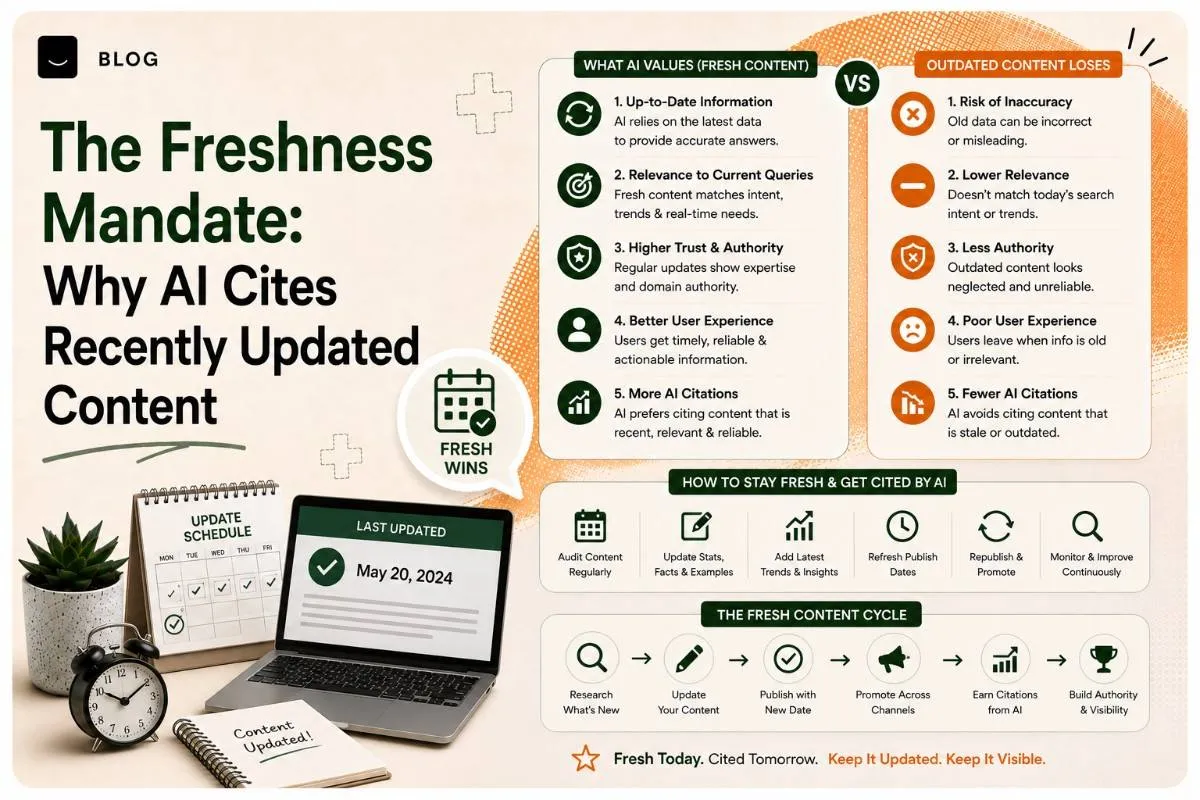
The Freshness Mandate: Why AI Cites Recently Updated Content
AI answer engines consistently favour recently updated content when answering questions where the correct answer could have changed. This is not a ranking factor in the traditional sense our GEO primer for Indian businesses it is a consequence of how these systems select sources. A 2023 page and a 2026 page saying similar things are not equivalent to an answer engine, and the practical implication for your content is that publishing is the beginning of a page's working life, not the end of it.
What the freshness mandate means
"Freshness mandate" is a useful shorthand for a pattern anyone doing Generative Engine Optimization notices quickly: when you ask ChatGPT, Perplexity, Gemini or Google's AI Overviews a question whose answer moves — a how-to, a pricing question, a "best tool for X", anything with a year implied in it — the sources cited skew heavily recent.
You can test this yourself in about ten minutes, and you should, because it is more convincing than reading it here. Take five questions your customers ask. Run them through three AI assistants. Look at the publication or update dates of what gets cited. The pattern usually shows up immediately.
What you are seeing is a selection preference, not a penalty. Older content is not being suppressed. Newer content is being preferred where the engine has reason to think currency matters.
Why answer engines behave this way
Three reasons, and understanding them is what tells you which pages to refresh.
An answer engine is accountable for the answer in a way a search engine is not. A list of ten blue links puts the judgment on the user. A stated answer carries an implicit claim of correctness. Preferring recent sources on time-sensitive questions is the cheapest way to reduce the risk of stating something that stopped being true two years ago.
A model's own knowledge has a cutoff, so retrieval is where currency comes from. When an assistant searches rather than answering from memory, it is doing so precisely because it needs current information. The retrieval step is the freshness step. Sources that look current are the ones that solve the problem retrieval was invoked to solve.
Query intent often carries an implied date. "Best CRM for a small business" means now, not in 2022. The user never types the year, but the expectation is there, and the engine acts on it.
Where the answer genuinely does not change — a definition, a historical fact, a mathematical explanation — this pull toward recency is much weaker. That distinction is the whole strategy.
VERIFY: Do not publish a percentage here. There are widely-circulated figures about how much of AI-cited content is under a certain age. Most trace back to vendor studies with undisclosed methodology, repeated secondhand across agency blogs until they read like established fact. If you want a number in this post, source it from a primary study you have actually read, and name the study and its sample. Otherwise leave the argument as it stands — it holds without a statistic, and the reader can verify it themselves in ten minutes.
Freshness is not the same thing as recency
This is where most content teams go wrong, and it is worth being blunt about it.
Changing a date stamp is not an update. Rewriting an introduction is not an update. Adding "in 2026" to a title is not an update. These are recency signals with no freshness behind them, and they fail for a simple reason: the engine is not reading your date field in isolation. It is reading the content. If the content still describes a tool interface that changed eighteen months ago, or recommends an approach that has since been superseded, no date stamp rescues it.
Worse, there is a real cost to faking it. A user who arrives from an AI citation on a page dated last month and finds instructions that no longer match reality does not conclude the AI was wrong. They conclude your site was.
Freshness means the information is currently accurate. Recency signals just tell a machine when to look. You need both, in that order.
What actually counts as an update
Updates that change what an engine can extract
- Correcting anything that has become wrong. Prices, interface descriptions, tool names, policy rules, steps in a process. This is the highest-value work and the least glamorous.
- Adding a genuinely new section covering a development, a tool, a method or a question that did not exist when the page was written.
- Answering the follow-up questions the page raised but never addressed. These are frequently the exact queries the page could be cited for.
- Replacing a vague passage with a specific one. "Costs vary considerably" is unextractable. A stated range, with what drives it, is extractable.
- Adding or correcting structured data — FAQ, Article, dateModified — so a machine can parse what changed.
- Removing content that is now wrong. Deletion is an update. A page gets stronger when the outdated third of it is gone.
Updates that change nothing
- Editing the date field alone
- Swapping synonyms or rewording sentences that were already correct
- Adding a paragraph of filler to raise word count
- Changing the title to include the current year while the body stays stale
- Republishing the same article under a new URL — which actively hurts, since it discards whatever authority the original had
How to signal freshness so a machine can read it
Once the content is genuinely updated, make the update legible:
- dateModified in Article schema, accurate and updated with the content. Keep datePublished as the original — both are useful, and overwriting the publish date looks like exactly the manipulation you are trying not to do.
- A visible "Last updated" line near the top, in text. Machines read it; so do readers, and it earns trust either way.
- A short changelog for substantially revised pages. Two or three lines: what changed, when, and why. Rare enough on the open web to be a genuine differentiator, and it gives an engine an explicit, extractable statement of currency.
- Consistent dates across schema, visible text, and sitemap lastmod. Contradictory signals are worse than none.
- Update internal links so the refreshed page is linked from your newer content, not stranded.
Which pages to refresh, and how often
Not everything needs a schedule.proving GEO actually works Sort your content into three groups:
High-decay — refresh quarterly. Anything about tools, platforms, pricing, AI capabilities, algorithm behaviour, regulations, or "best of" lists. These break fast and break quietly.
Medium-decay — refresh annually. Strategy guides, how-tos for stable processes, industry overviews. The framework holds; the examples and screenshots age.
Low-decay — refresh when something actually changes. Definitions, conceptual explainers, historical background. Refreshing these on a calendar wastes effort that the high-decay group needs, and these are also the pages where the freshness pull is weakest anyway.
A workable rule for most sites: refresh before you publish new. A page that already has some authority and some links, brought back to accuracy, will usually outperform a brand-new page on the same subject.
A quarterly refresh workflow you can actually run
- List every page in the high-decay group. Sort by traffic or by strategic importance, whichever you can measure.
- For the top ten, read them as a customer would. Not skim — read. Note every claim that is no longer true.
- Run each page's core question through ChatGPT, Perplexity and Google AI Overviews. check where you currently stand in AI answers Note whether you are cited and, if not, what is being cited instead. That competing source usually tells you exactly what your page is missing.
- Fix the errors first, then add what is missing, then delete what is now dead weight.
- Update dateModified, the visible "Last updated" line, and the changelog.
- Re-link internally from newer posts.
- Re-run the same queries in four to six weeks and record any change.
Ten pages a quarter is a realistic pace for a small team and is more valuable than thirty new posts on subjects you have already covered.
How to check whether it worked
Set expectations honestly here. AI citation is not yet measurable with the precision of rank tracking, and there is no reliable way to isolate a single refresh as the cause of a single citation. Measuring citation share What you can do:
- Track citation manually. A fixed set of ten to twenty priority prompts, run monthly across three assistants, recorded in a spreadsheet. Unglamorous and effective.
- Watch branded search in Search Console. Rising branded queries with flat click volume is a reasonable proxy for zero-click AI exposure.
- Segment AI referral traffic in GA4 from chatgpt.com, perplexity.ai and gemini.google.com. Volumes are typically small; the value is in the trend, not the absolute number.
- Watch traditional rankings too. Refreshed pages often gain in conventional search as well, which is a faster and cleaner signal than citation tracking.
What freshness cannot fix
An updated date on a page nobody would cite anyway changes nothing. Freshness is a tiebreaker between credible sources, not a substitute for being one.
If the page is thin, if it hedges rather than answering, if it is written by no one identifiable, or if nothing on the web indicates the site knows the subject — updating it will not put it into an AI answer. Crescent's content writing team Fix those things first, then keep the result current. That order matters, and reversing it is the most common way a refresh programme produces nothing.
Frequently asked questions
Substantively updating content — correcting what has become inaccurate, adding genuinely new information, removing what is obsolete — improves the chance of being cited on questions where currency matters. Changing only the date stamp does not, because answer engines assess the content itself, not just the date field attached to it.
A real update changes what a reader or an answer engine can take from the page: corrected facts, new sections covering developments since publication, newly answered follow-up questions, replaced vague passages, updated structured data, or removal of obsolete material. Rewording accurate sentences or adding filler does not qualify.
It depends on how fast the subject changes. Content about tools, pricing, platforms, regulations or AI capabilities benefits from quarterly review. Strategy and how-to content covering stable processes can be reviewed annually. Definitional and conceptual content only needs updating when something genuinely changes.
No. Keep the original publication date and update the dateModified field in Article schema, alongside a visible "Last updated" line. Overwriting the publish date removes useful information and resembles the date manipulation that undermines trust with both readers and search systems.
For most sites, refreshing existing content first produces better returns. An established page already carries accumulated authority, internal links and any external links it has earned. Bringing it back to accuracy typically outperforms publishing a new page that has to build all of that from nothing.
Because an answer engine states an answer rather than offering a list of options, it carries more responsibility for that answer being correct. Preferring recent sources on questions where the answer could have changed is a low-cost way to reduce the risk of stating outdated information. The preference is much weaker on questions where the answer does not change.
No. Freshness acts as a tiebreaker between sources an engine already considers credible. A thin, vague or unattributed page will not be cited regardless of how recently it was updated. Depth, specificity, clear authorship and topical authority come first; keeping it current is what protects that position over time.
Ready to build what's next?
Tell us where you're headed. We'll come back with a plan to get there.
Book an intro call