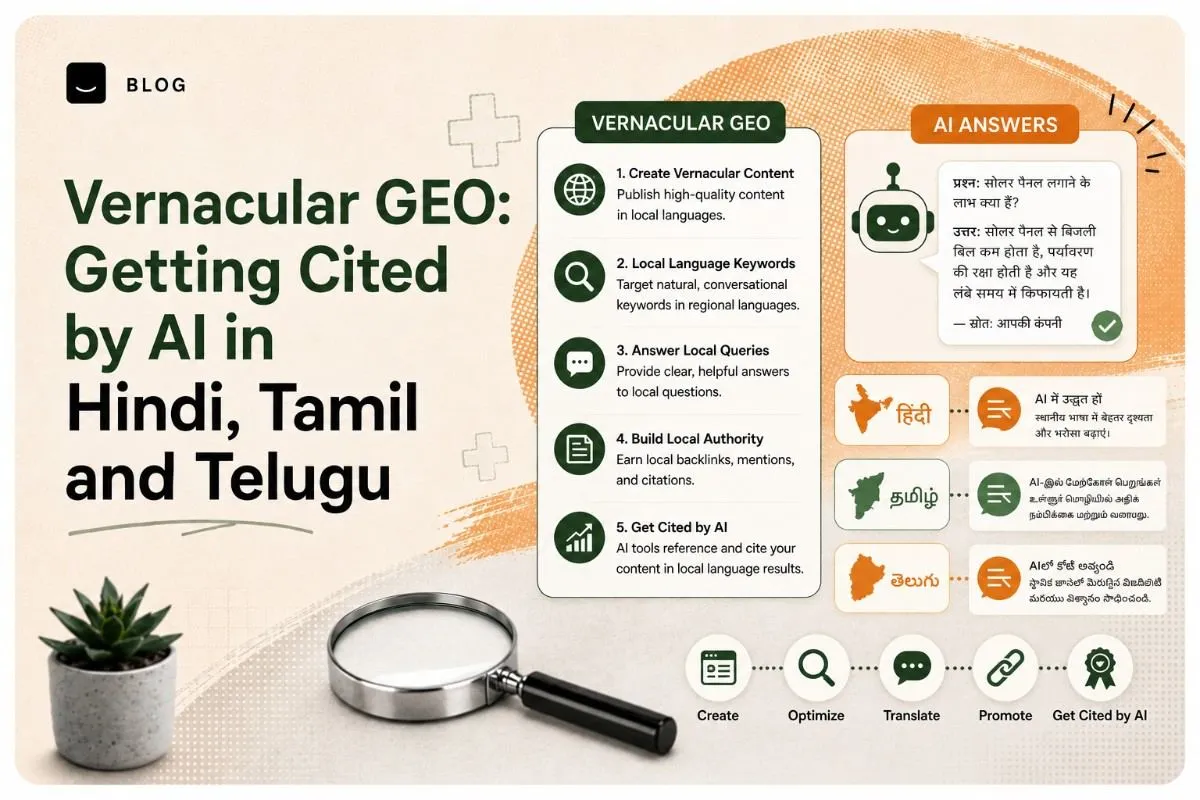
Vernacular GEO: Getting Cited by AI in Hindi, Tamil and Telugu
Vernacular GEO is the practice of structuring regional-language content so AI answer engines — ChatGPT, Perplexity, Gemini and Google's AI Overviews — cite your business when someone asks a question in Hindi, Tamil, Telugu or another Indian language. It's the same discipline as Generative Engine Optimization for Indian businesses, generative engine optimization, applied to the languages most Indians actually search in.
Almost nobody is doing it. Global agencies publish GEO advice written for English-speaking Western buyers. Indian agencies mostly publish English content for English queries. That leaves a genuine gap: a large and growing share of Indian AI queries happen in regional languages, and very few businesses have published anything an AI model could cite when answering them.
Terminology note: GEO here means Generative Engine Optimization — being cited by generative AI. It does not mean geographic SEO. Ranking in a specific city is Local SEO, a separate discipline.
What is vernacular GEO?
Vernacular GEO combines two things most businesses treat separately: regional-language content and optimisation for AI citation.
Publishing a Hindi page is not vernacular GEO. Publishing a Hindi page that answers a real question plainly, uses the vocabulary people actually type, carries clear signals about who you are, and gets picked up as a source when someone asks ChatGPT that question in Hindi — that's vernacular GEO.
The distinction matters because most regional-language content on Indian websites is a machine translation of the English page, published once and forgotten. AI models are unusually bad at citing that kind of content, for reasons worth understanding.
Why almost nobody is doing this yet
Three reasons, and each one is an opening.
Translation is treated as a checkbox. Most businesses run their English page through a translation tool, publish it, and move on. The result reads unnaturally to a native speaker and rarely matches the phrasing people actually use — so it doesn't get cited.
Keyword tools show thin data for regional languages. Search-volume tools return sparse numbers for Hindi and regional queries, so businesses conclude there's no demand and skip it. But AI prompting volume isn't captured by those tools at all. Absence of keyword data is not absence of demand — it's just absence of measurement.
The global playbooks don't cover it. Search "generative engine optimization" and you'll find excellent guides, all written about English-language content for US and European markets. None of them address what happens when the query arrives in Tamil.
How AI models handle Indian languages
A few practical realities shape everything below.
Large language models are trained overwhelmingly on English text. Their Indian-language capability is real but thinner, which means they have fewer high-quality sources to draw on when answering a regional-language question. Fewer competing sources is precisely why the opportunity exists — the bar to become a cited source is lower. voice search in tier-2 and tier-3 India
Models also handle script and transliteration inconsistently. A user might type a Hindi question in Devanagari, in Roman script, or in a mix. The same question in three forms can produce three different answers drawing on different sources.
And because good regional-language source material is scarcer, models more often fall back on English sources to answer a regional-language question, then respond in the user's language. This has a direct implication: strong English content still helps you get cited in vernacular answers — but native regional content helps more, and almost nobody has it.
Where vernacular GEO actually pays off
Not every business needs this. It pays off most clearly when:
- Your customers are in tier-2 and tier-3 cities, where regional-language usage is highest.
- You sell something researched before buying — healthcare, education, financial services, solar, real estate — where people ask questions before they commit.
- Your category involves explanation, not just transaction. Anything a customer needs to understand first is a natural fit.
- You operate in a specific linguistic region — a Tamil Nadu business publishing in Tamil has far less competition than one publishing in English.
If you sell exclusively to English-speaking metro professionals, this is lower priority. For most Indian businesses serving a regional market, it's an unclaimed advantage.
How to build content that AI cites in Indian languages
1. Write natively, don't translate
Machine-translated content reads as translated, and it misses the vocabulary people actually use. A native speaker writing directly in Hindi will naturally use the terms, phrasings and colloquialisms your customers type.
If budget is tight, translate as a first draft and have a native speaker rewrite — but never publish raw machine output.Our content writing service
2. Match the script people actually type
Decide deliberately whether your audience searches in Devanagari, in Roman script, or both — and cover the realistic cases. Many users type Hindi questions in English letters.
Content that only exists in Devanagari can miss them entirely, and vice versa. Where it fits naturally, include both forms of key terms.
3. Answer the question in the first two sentences
This is the single highest-leverage AEO and GEO habit in any language. State the direct answer plainly at the top, then explain.
Models extract from clear, early answers — and in a language with fewer competing sources, a clearly-stated answer stands out sharply.
4. Keep your entity signals in English and the local language
Your business name, category, city and contact details should be consistent and findable in both.
This helps a model connect your regional-language content to the same entity as your English presence, rather than treating them as two unrelated businesses.
5. Use structured data with language markers
Mark up your pages with schema and declare the page language correctly using the lang attribute and hreflang where you have parallel versions.
This won't force a citation, but it removes ambiguity about what the page is and who it's for.
Hinglish: the case nobody plans for
A large share of Indian users don't type in pure Hindi or pure English — they mix. "Best solar panel ka price kya hai" is a real query shape, and it's one almost no business writes content for.
You can't build a whole content strategy on Hinglish, and it's awkward in formal brand copy. But it belongs in two places where it reads naturally: FAQ sections, where you can phrase a question the way a customer would actually ask it, and conversational content like community posts or chat responses.
Including the genuine mixed-language phrasing in an FAQ answer costs nothing and captures a query pattern your competitors have ignored entirely.
How to test whether it's working
Run the same AI visibility check you'd run in English, in the target language:
- Write 10–15 questions your customers would ask, in the regional language — including transliterated and mixed-script versions.
- Ask each in ChatGPT, Perplexity and Gemini, using a fresh chat each time.
- Record whether you're cited, merely mentioned, absent, or described inaccurately. The metrics that replace rankings
- Note which sources are getting cited — often English pages or large aggregators, which tells you exactly what you're competing against.
- Re-run quarterly.
Because regional-language competition is thinner, movement here often shows up faster than in English.
Where to start if you only have budget for one language
Pick the language of your largest customer base, not the largest language nationally. A Bhopal or Udaipur business serves a Hindi-speaking market; a Coimbatore business serves Tamil.
Publishing excellent Tamil content for a Tamil customer base beats publishing mediocre Hindi content because Hindi has more speakers overall.
Then start narrow: take your five highest-value questions — the ones customers ask before buying — and answer each one properly in that language. Five genuinely useful native-language pages will outperform fifty translated ones.
Vernacular GEO is one of the few areas in digital marketing right now where being early is still genuinely possible. The global playbooks haven't covered it, the keyword tools under-report it, and most of your competitors have concluded there's no demand because the data looks thin. That's usually what an opportunity looks like before everyone agrees it's one.
Want a vernacular GEO plan built around the languages your customers actually search in?
Contact Crescent for a free consultation.
Frequently asked questions
Vernacular GEO is the practice of structuring regional-language content so AI answer engines such as ChatGPT, Perplexity, Gemini and Google's AI Overviews cite your business when someone asks a question in Hindi, Tamil, Telugu or another Indian language. It applies generative engine optimization to the languages people actually search in.
Raw machine translation rarely performs well, because it misses the vocabulary and phrasing native speakers actually use and reads unnaturally. Content written natively in the language, or machine-translated and then rewritten by a native speaker, is far more likely to be cited by AI answer engines.
It depends on how your audience types. Many Indian users type Hindi questions using English letters rather than Devanagari, so content existing only in one script can miss a large share of queries. Where it reads naturally, include both forms of key terms and cover the realistic cases for your audience.
Start with the language of your largest customer base rather than the largest language nationally. A business serving Tamil Nadu should publish in Tamil even though Hindi has more speakers overall, because relevance to your actual customers matters more than total speaker count.
Global GEO guidance is written for English-language Western markets, most Indian businesses publish in English, and keyword tools report thin data for regional languages, leading many businesses to assume there is no demand. AI prompting volume is not captured by those tools, so the gap reflects a lack of measurement rather than a lack of demand.
Ready to build what's next?
Tell us where you're headed. We'll come back with a plan to get there.
Book an intro call