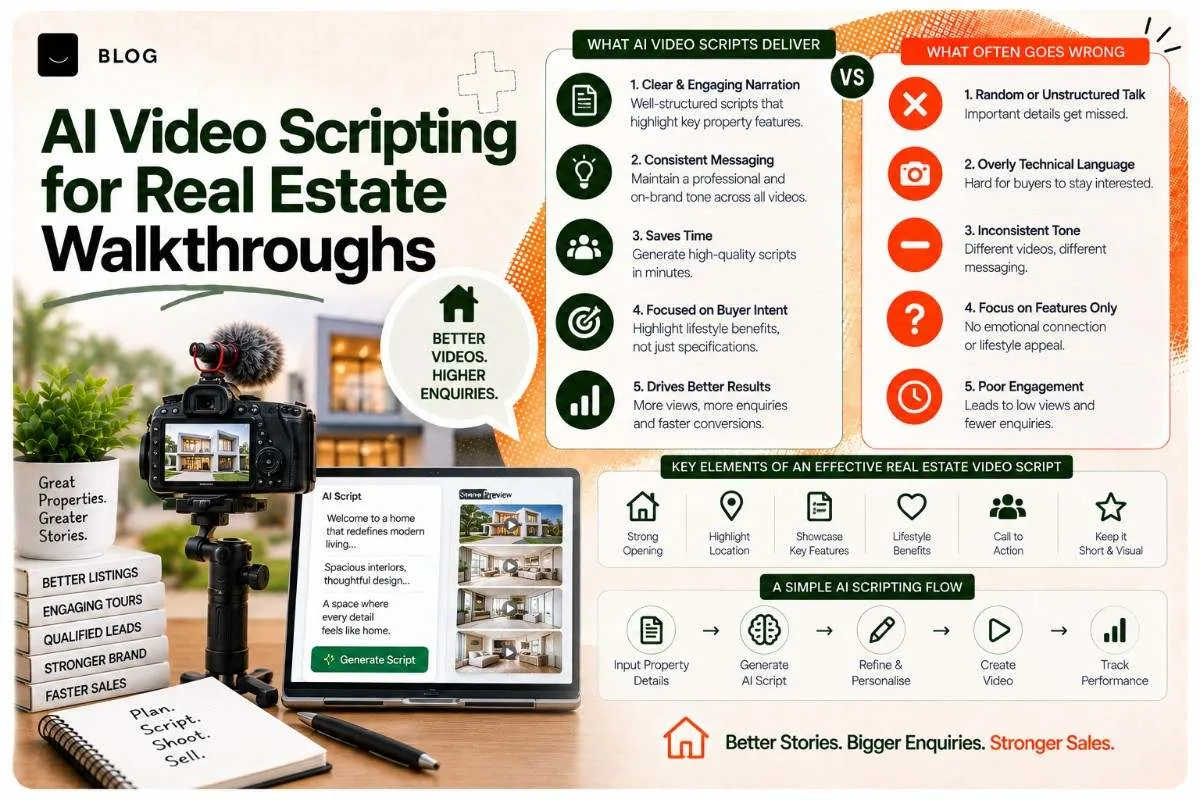
AI Video Scripting for Real Estate Walkthroughs
A walkthrough script is not a list of rooms. It is a sequence of specific, verified details delivered in the order a buyer would actually want them, timed to what the camera shows. AI drafts this well once it has real information to work with — the failure mode is not the AI, it is agents skipping the step where they supply the specifics. This post covers the workflow, a prompt template, and what needs checking before anyone hits record.
Why walkthrough videos usually sound the same
Most property walkthrough videos share a script, whether or not anyone wrote one down: "Welcome to this beautiful property. As we enter, you'll notice the spacious living room. Moving on to the kitchen, we have modern fittings." Then a slow pan of every remaining room in the same tone.
It is not that agents are bad at this. Scripting a walkthrough from scratch, for every listing, is genuinely time-consuming, and the fallback under time pressure is generic narration that technically describes the property without saying anything a viewer could not have guessed from the footage alone.
This is a case where AI suits the actual bottleneck — not because it knows more about the property, but because turning organised facts into a spoken, timed script is exactly the kind of structuring task it does quickly, provided a person supplies the facts.
What a script actually needs to do
Three jobs, and most generic scripts only attempt the first:
Describe what the camera is showing, so a viewer without you in the room understands what they are looking at.
Add what the camera cannot show — the direction the room faces, the actual room dimensions, what is beyond the frame, how the space compares to what a viewer might expect at this price point.
Move the viewer through in an order that mirrors how they would actually experience the property, not the order that was most convenient to film.
Most fallback scripts do only the first. The second is where the script earns its place — it is information a viewer could not get from the raw footage — and it is also the part that requires an agent's input rather than the model's imagination.
The information only the agent has
Before any script gets written, this needs to exist as notes. It cannot be generated.
- Exact dimensions of each significant room, not estimates
- Orientation — which direction rooms face, whether that matters for light or heat in the local climate
- What is genuinely notable, specifically — not "premium fittings" but which fittings, and why they are notable
- Distances to things buyers actually ask about — schools, transit, markets, the highway
- Age and condition of major systems — roof, wiring, plumbing — stated honestly
- What is not included or not functional, if anything, so the video does not imply something untrue
- The three things about this specific property that a buyer comparing it to five others would want to know first
That last point is what turns a script from generic to useful. Every property has two or three genuinely distinguishing facts. A script that leads with them is doing something a template cannot.
The prompt template
Paste your own property notes into the brackets. The quality of the output is set almost entirely by how complete these notes are.
You are writing a spoken video script for a real estate walkthrough video. The audience is a prospective buyer who has not visited the property. The tone is confident and informative, not a sales pitch — buyers respond better to specific description than to enthusiasm. PROPERTY TYPE: [apartment / independent house / plot, etc.] LOCATION: [area, city] ROOM SEQUENCE AS FILMED: [the actual order the footage will show, room by room] VERIFIED DETAILS PER ROOM: [for each room: dimensions, orientation, notable features, condition — paste your raw notes, they do not need to be polished] DISTINGUISHING FACTS: [the two or three things that make this property different from comparable listings] NEARBY: [schools, transit, markets, highway access — only what is verified] WHAT TO AVOID SAYING: [anything not included, not functional, or that could overstate the property] Write the script as timed spoken lines, one line per shot or room, matching the filmed sequence above. Each line should describe what is on screen AND add one fact the camera does not show. Rules: - Do NOT invent any dimension, distance, feature or claim not in the notes above. If a room needs a detail I have not provided, write [NEED: what is missing] instead of estimating. - No superlatives without a specific fact behind them — not "stunning kitchen," but what makes it notable. - Keep each line short enough to read naturally in the time one shot lasts, roughly 8-12 seconds of footage. - End with a plain statement of next steps, not a pressure close.
The [NEED: ...] instruction does the same job it does elsewhere in this library — it converts the model's instinct to fill gaps with plausible invention into a checklist for the agent to complete before filming.
The four-part structure that holds up on screen
Regardless of property size, this ordering consistently works better than a room-by-room list:
- Opening context — location, property type, and the one fact that frames everything that follows. Five to ten seconds.
- The sequence that mirrors actual arrival — entrance, common spaces, then private spaces, in the order a visitor would naturally move through them, not the order convenient for filming.
- The distinguishing facts, placed where they are visually relevant rather than saved for the end — if the kitchen is the standout feature, say so when the camera is on the kitchen.
- A close that states next steps plainly — what to do to see it in person, and what to have ready (a specific fact, not "contact us today").
What to change before filming
The script is a draft of what to say, not a rigid transcript. Three adjustments the presenter should always make:
- Read it aloud once before filming. Written sentences and spoken sentences are different; a line that reads fine often sounds stiff aloud.
- Cut anything that does not match the actual footage timing. A script written before filming will occasionally run long or short against what the camera actually captured.
- Add anything spontaneous and true. If something genuinely good happens during the walkthrough — good natural light, a passing detail — say so. That authenticity is worth more than script adherence.
Turning the script into text that also helps you get found
A script written this way is, with light editing, a strong property description for your listing page — and this is where the work compounds.
The same verified details that make the video specific are exactly what a listing page needs to be found in search and cited in AI answers about properties in that area. Publish the script (adapted from spoken to written register) as the listing description, with the dimensions and distinguishing facts as actual text on the page rather than only spoken in the video.
This closes a gap covered elsewhere in this library: video content is largely invisible to AI answer engines unless the spoken content also exists as text somewhere a crawler can read. A walkthrough script published as a listing description solves that automatically, because you were going to write the description anyway.
What AI gets wrong in this specific task
Worth being direct about, because a confident script is easy to trust past the point it deserves.
- Dimensions and distances. The model will produce a plausible number if you do not supply one. Never let an estimated figure survive into the final script.
- Claims about neighbourhood quality or investment potential. "Excellent investment opportunity" is the kind of line a model generates readily and that carries real regulatory and reputational risk if it is not something the agent can stand behind.
- Assuming amenities exist. A general "gym and clubhouse" line for any apartment complex is the kind of filler a model defaults to. If the property does not have it, this is actively harmful, not just imprecise.
- Pacing for the actual footage. The model does not know how long your shots run. Someone has to check the script against the real footage timing.
A workable workflow, start to finish
- Before filming: walk the property and take structured notes — dimensions, orientation, notable features, condition, distinguishing facts. This step determines script quality and it cannot be skipped or generated.
- Film in a sensible sequence, roughly matching how a visitor would move through.
- Generate the script from the prompt template, using your notes.
- Read it aloud, adjust for timing, resolve every [NEED] flag.
- Record narration, or have the agent read live during a second pass.
- Adapt the script into the listing description, publishing the verified details as text.
- Reuse the distinguishing facts across the video caption, the listing page and any WhatsApp material sent to interested buyers — one set of verified facts, several formats.
Frequently asked questions
Yes, and it does this well once given verified property details — dimensions, orientation, notable features and distinguishing facts. AI should not be relied on to supply those details itself; a language model will produce a plausible but potentially false dimension or amenity claim if the agent does not provide accurate notes first.
A generic script describes only what the camera shows, which a viewer could largely infer without narration. A useful script also adds what the camera cannot show — exact dimensions, orientation, distances to relevant places, and the facts that distinguish this property from comparable listings.
Exact room dimensions, orientation, condition of major systems, genuinely notable features stated specifically, verified distances to nearby amenities, and anything not included or not functional. This cannot be generated by AI and determines the entire quality of the resulting script.
Adapted, yes. The verified details that make a script specific are the same information a listing page needs to be found in search and referenced in AI-generated answers about properties in an area. Publishing the script's factual content as text on the listing page makes that information usable beyond the video.
Inventing plausible but unverified dimensions or distances, assuming standard amenities that a specific property may not have, and generating investment or neighbourhood claims that carry regulatory risk if the agent cannot substantiate them. Every specific claim should be checked against verified notes before filming.
Timed to the footage rather than to a fixed word count — roughly one short line per 8 to 12 seconds of shot. A script written before filming should be checked against the real footage and adjusted if scenes ran longer or shorter than planned.
Only if the spoken content also exists as readable text somewhere, since AI answer engines work primarily from text rather than watching video. Publishing the script's verified details as the listing description turns content that would otherwise be spoken-only into something that also supports search and AI visibility.
Ready to build what's next?
Tell us where you're headed. We'll come back with a plan to get there.
Book an intro call