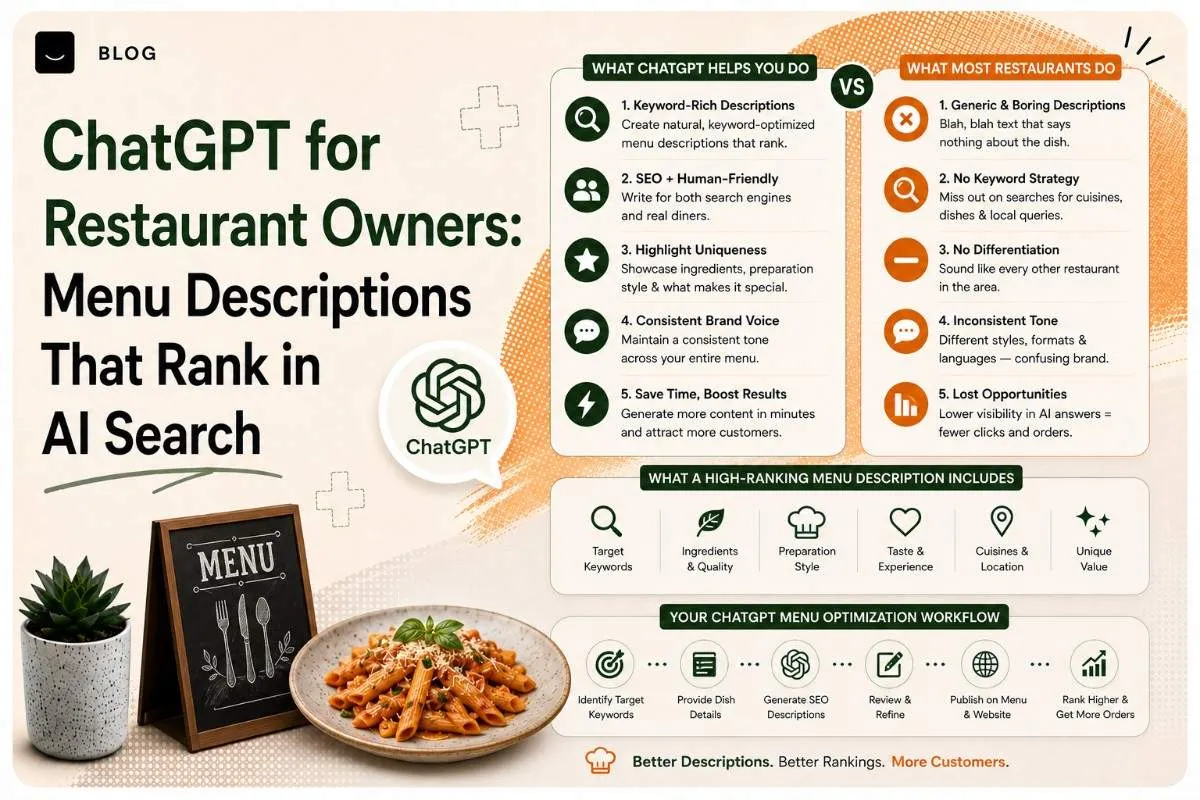
ChatGPT for Restaurant Owners: Menu Descriptions That Rank in AI Search
ChatGPT can turn a bare dish name and a list of ingredients into a menu description that does two jobs at once — makes a diner want to order it, and gives search engines and AI assistants enough specific, readable text to surface the dish when someone asks a relevant question nearby. Most restaurant menus do neither, because they're published as an image or a PDF that neither a diner searching online nor a crawler can actually read.
This is a practical, one-workflow guide: how to use ChatGPT to fix that, dish by dish.
Why most restaurant menus are invisible to search and AI
Two separate problems compound here. First, many restaurant websites publish the menu as a photographed page or a PDF, which means the dishes, prices and descriptions are effectively invisible to search engines and AI models — nothing in that image can be read, indexed or cited. Second, even restaurants that publish text menus often write single-word dish names with no description, which gives a search engine or an AI assistant nothing to match against a diner's actual question.
A diner asking an AI assistant "where can I get good vegetarian food near me that's open now" needs a source that clearly states vegetarian options exist. A menu that just says "Paneer Tikka" with no further detail can't answer that question, even if the dish itself would be a perfect match.
What makes a menu description actually work
A good AEO-ready menu description does three things a decorative one usually skips: it states what the dish actually contains, it flags dietary information explicitly, and it uses the specific words a diner would search for — cuisine type, key ingredients, preparation method.
"A delightful culinary journey" describes nothing searchable. "Cubes of cottage cheese marinated in yoghurt and spices, char-grilled in a tandoor" describes an actual dish, reads well to a human, and gives an AI system real content to extract from.
The ChatGPT workflow, step by step
1. Give ChatGPT the raw facts, not adjectives
Start with what's actually true about the dish: main ingredients, how it's cooked, what it's served with, spice level, and any dietary flags.
Feed ChatGPT the facts and let it handle the phrasing — starting from marketing language instead produces vague copy with nothing concrete underneath it.
2. Ask for the AEO version, not the poetic version
Explicitly ask for a description that names the ingredients and preparation method in plain language, rather than a purely evocative one.
Both can coexist — a well-written description can be appetising and specific at the same time — but if you don't ask for the specific version directly, ChatGPT will default toward the flowery one, which is worse for both diners scanning quickly and AI systems reading for facts.
3. Cover dietary and allergen information explicitly
Ask for a short, separate line for each dish flagging vegetarian, vegan, Jain, gluten-free or nut-containing status where relevant.
These are exactly the constraints diners type into conversational searches — "vegetarian options near me," "gluten-free menu" — and they need to be stated plainly, not implied.
4. Have someone who has actually tasted the dish check it
This step matters more than it sounds.
ChatGPT does not know your kitchen, your recipe, or your actual spice level — it can only generalise from how a dish is typically made.
Every description needs a check from someone who has actually eaten it, both for accuracy and because an inaccurate description damages trust with a diner far more than a plain one would have.
A prompt template you can copy
I run a [cuisine type] restaurant. I need menu descriptions for [number] dishes that are specific and appetising, and that also work well for search engines and AI assistants that answer questions like "best [cuisine] near me" or "vegetarian food near me." For each dish, I'll give you: the name, main ingredients, cooking method, and any dietary notes. Write each description in 15-25 words. State the actual ingredients and preparation method in plain language rather than only using evocative adjectives. Add a separate short line flagging vegetarian, vegan, Jain, gluten-free or nut-containing status if relevant. Dish 1: [name] — [ingredients] — [cooking method] — [dietary notes] Dish 2: [name] — [ingredients] — [cooking method] — [dietary notes] [continue for each dish]
Batch several dishes into one conversation rather than one at a time — ChatGPT keeps a consistent tone across the batch, which matters for a menu that needs to read as one voice.
Turning the same descriptions into an FAQ
Once the descriptions exist, the same source material answers the questions diners actually ask before they visit — "do you have vegetarian options," "is anything gluten-free," "what's your spiciest dish."
Ask ChatGPT to draft a short FAQ pulling directly from the dish list, grouped by dietary need rather than by menu section.
This turns one piece of work into two genuinely useful assets, and an FAQ page is one of the most reliably extracted formats for AI answer engines.
What ChatGPT should not decide
ChatGPT should not decide what the restaurant is actually known for, which dishes to feature first, or how spicy something genuinely is — those are judgment calls that belong to the people running the kitchen.
Its job here is turning accurate input into clear, structured, searchable text — not generating the facts about the food itself.
Treat every draft as something to edit against what's actually true, not something to publish unchanged.
Conclusion
Most restaurants lose this opportunity in one of two ways — a menu nobody but a human can read, or dish names with nothing readable behind them.
Fixing it is a few hours of structured work with ChatGPT and a final check from someone who has actually eaten the food, and it pays off in both search visibility and diners who know exactly what they're ordering.
Want your full menu turned into search- and AI-ready content, done properly?
Contact Crescent for a free consultation.
Frequently asked questions
Yes, when given the actual ingredients, cooking method and dietary details for each dish. ChatGPT can turn those facts into descriptions that are both appetising to diners and specific enough for search engines and AI assistants to reference, though every description should be checked against the real dish before publishing.
A menu published as a photographed page or PDF is effectively invisible to search engines and AI models, since the dish names, prices and descriptions inside an image cannot be read or indexed. Publishing the menu as real, selectable text is necessary for it to be found or cited.
The actual ingredients, the preparation method in plain language, and explicit dietary information such as vegetarian, vegan, Jain, gluten-free or nut-containing status. Specific, factual descriptions give both diners and AI systems something concrete to match against a search, unlike purely decorative language.
Yes, always. An AI model does not know your specific recipe or actual spice level, and can only generalise from how a dish is typically made. Someone who has actually eaten the dish should verify every description for accuracy before it is published.
Yes. The same accurate ingredient and dietary information used for menu descriptions can be reorganised into an FAQ answering common diner questions, such as which dishes are vegetarian or gluten-free. FAQ-formatted content is one of the formats most reliably extracted by AI answer engines.
Ready to build what's next?
Tell us where you're headed. We'll come back with a plan to get there.
Book an intro call