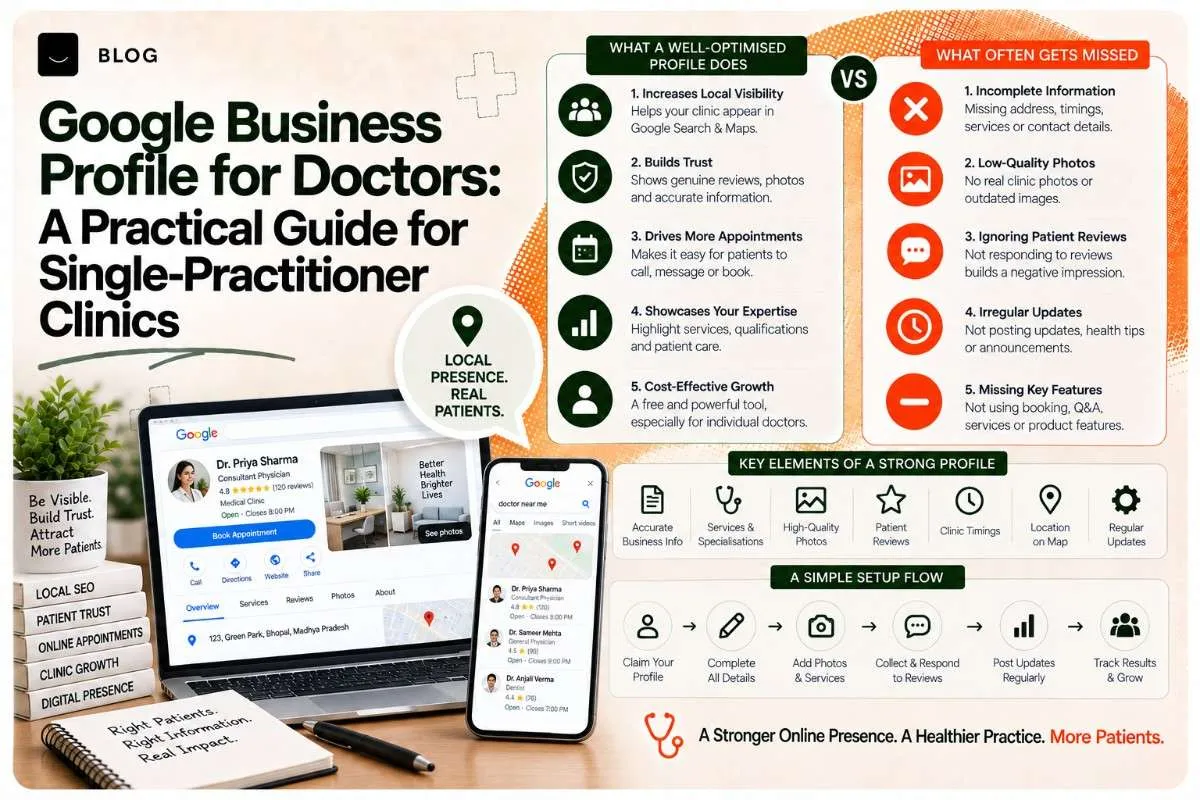
Google Business Profile for Doctors: A Practical Guide for Single-Practitioner Clinics
For most single-practitioner clinics in India, the Google Business Profile is the first thing a prospective patient sees and the main thing AI assistants read when asked about local doctors. Getting it complete and accurate does more for patient discovery than almost anything else available, and it is free. This guide covers the fields that matter, the ones most clinics leave empty, and the professional conduct considerations that shape what belongs on it.
A note on professional conduct rules
Registered medical practitioners in India are subject to professional conduct regulations that govern advertising and solicitation. The boundaries are not always obvious, and they matter more than any visibility benefit discussed below.
This guide is therefore written around one principle: provide accurate factual information about the practice; do not make promotional or comparative claims. A complete, truthful listing of who you are, what you treat, where you are and when you are open is a very different thing from advertising superiority.
This is not legal advice, and this post should not be treated as a compliance opinion. Practitioners should verify their obligations against the current regulations and, where there is any doubt, take advice. If a tactic anywhere below sits uncomfortably against your reading of the rules, do not use it — the visibility gained is not worth a professional conduct question.
VERIFY: Mandatory before publishing: review this post against the current National Medical Commission professional conduct regulations, confirm the position on online listings and patient reviews for registered practitioners, and consider a lawyer's review of this section and the reviews section. Do not publish without this step.
Why the profile matters more than the website for most clinics
Uncomfortable but true for a large share of Indian clinics.
A patient searching for a doctor rarely reads a clinic website carefully. They look at what appears in Maps and search results: name, specialisation, distance, hours, whether it looks open, whether the phone number works, what other patients said. The decision often happens entirely inside that panel.
The same information is now feeding AI answers. When someone asks an assistant about doctors in their area for a particular condition, profile data is a primary source. A clinic with an incomplete profile is not competing badly — it is frequently absent from the answer altogether.
For a clinic with limited time and no marketing budget, this is the highest-return place to spend two hours.
Getting the basics exactly right
Name
The practice or clinic name exactly as it appears on your signage, registration and prescriptions. One spelling, used identically everywhere.
Do not append keywords or descriptors that are not part of the actual name. Beyond being against platform guidelines, an inflated name creates inconsistency with your other records — and consistency is precisely what helps a system identify you confidently.
Categories
Choose the primary category that most precisely describes the practice, then add relevant secondary categories. Precision beats breadth: a specific specialisation category matches a specific patient search far better than a general one.
Review the available categories properly rather than accepting the first suggestion. Most clinics use a broader category than they need to.
Address and service area
Full, correctly formatted address, with the pin placed accurately. Check the pin on a map yourself — misplaced pins are common in Indian cities and send patients to the wrong building.
Match this address exactly to what appears on your website, your prescriptions and any directory listing. Inconsistent addresses fragment your identity across systems.
Hours
Accurate consulting hours, including different hours on different days, and special hours for festivals and holidays.
This is the field with the most immediate patient consequence. Wrong hours mean a patient travels to a closed clinic, and that produces exactly the review you do not want.
Phone and booking
A number that is answered during the hours listed. If you use a booking system, link it. If appointments are by phone only, say so.
Test the number from an outside line. Numbers that ring unanswered, are disconnected, or route to a personal phone nobody checks are more common than you would expect.
The fields most clinics leave empty
This is where the practical advantage sits, because most listings stop after name, address and phone.
- Services or treatments. List the conditions and procedures you actually handle. Factual, specific, no superiority claims. This is what allows a specific patient search to match you.
- Accessibility attributes. Wheelchair access, lift availability, accessible washroom, parking. Genuinely useful information that patients with mobility needs actively search for, and almost nobody fills in.
- Payment methods accepted. Including whether you accept specific insurance or cashless arrangements, if that is factual and current.
- Languages spoken. Materially useful in most Indian cities and rarely stated.
- Appointment requirements. Whether walk-ins are accepted or appointments are required.
- From the business / description. A plain factual description of the practice — qualifications, specialisation, years in practice, what the clinic does. Keep it factual; avoid comparative or promotional language.
- Opening date. Simple credibility signal, trivially easy.
Each empty field is a question a system cannot answer about you — and increasingly, "there isn't enough information about this place" is what a patient sees.
Photographs — what helps and what to avoid
Helpful: exterior showing the building and signage as it looks from the street, entrance and how to find it, reception and waiting area, the consulting room, and parking if relevant.
The exterior photograph is the most practically useful and most often missing. Patients navigating an unfamiliar area are matching what they see to what they saw online.
Avoid entirely: any image of a patient without documented consent, anything identifying a patient including visible records or displayed scans, before-and-after treatment images, and anything that could read as advertising a treatment outcome.
VERIFY: Confirm the position on treatment imagery against current professional conduct regulations before publishing this section.
Reviews, handled carefully
Reviews affect visibility and patient decisions. They also sit close to professional conduct boundaries, so the framing matters.
Generally safe: ensuring patients know the profile exists, responding to reviews professionally, and correcting factual inaccuracies without disclosing any patient information.
Handle with care: actively soliciting reviews. Practices vary and the regulatory position deserves checking rather than assuming. VERIFY
Never: incentivised reviews, reviews written by staff or family, or any response that confirms someone was a patient or discusses their care. Confidentiality applies in a review reply exactly as it applies anywhere else — a reply saying "we're sorry your knee replacement recovery was difficult" has disclosed a patient's medical information in public.
A safe reply to a negative review acknowledges the feedback, offers a private channel, and discloses nothing. Keep it short.
What the profile now feeds
Worth understanding, because it changes what completeness is for.
Google replaced the crowdsourced Q&A section on business profiles with Gemini-powered answers that draw on profile data, reviews and the web. A patient can now ask a question about your clinic and receive an AI-generated answer immediately — one you did not write and cannot edit.
The only thing you control is the source material. Every attribute you complete is a question that gets answered accurately rather than guessed at or left unanswered. That is the strongest practical argument for filling in the fields nobody fills in.
Multi-practitioner and multi-location clinics
Rules differ from the single-practitioner case, and getting this wrong creates duplicates that damage visibility.
- A practice with multiple doctors at one location generally has one profile for the practice, with individual practitioner profiles handled separately according to platform guidelines
- Multiple locations need separate profiles with distinct, accurate data — not duplicates with the city name changed
- Duplicate listings should be identified and resolved rather than left competing with each other
VERIFY: Confirm current platform guidelines for healthcare practitioner listings before publishing this section; they are more specific than for most business types.
A quarterly maintenance routine
Twenty minutes, four times a year:
- Check hours, including upcoming festival and holiday dates
- Call the listed number from an outside line
- Read new reviews and reply to any without a response
- Check for duplicate listings
- Confirm services listed still match what you offer
- Add a recent photograph
- Ask an assistant three questions a patient would ask about your clinic, and note anything wrong
Step 7 is the one that finds problems the others miss.
What a profile cannot do
- It cannot substitute for a website. The profile handles discovery; a website handles the questions a patient has before booking.
- It cannot make an inaccessible clinic accessible. Wrong hours, unanswered phones and inaccurate addresses are operational problems that no amount of profile work fixes.
- It cannot resolve a review problem caused by the underlying experience. Fixing the cause moves ratings; managing the profile does not.
- It cannot be optimised through promotional claims. Beyond the professional conduct issue, the systems reading it are looking for accurate factual detail, not superlatives.
Frequently asked questions
For most clinics it is the primary way patients find and reach them, and it is increasingly the main source AI assistants use when asked about local practitioners. A complete, accurate profile is generally the highest-return step available. Practitioners should ensure the content is factual rather than promotional, in line with professional conduct obligations.
Factual information about the practice: qualifications, specialisation, conditions and procedures handled, years in practice, and practical details like languages spoken and appointment requirements. Avoid comparative or promotional claims, guarantees about outcomes, and anything that could be read as advertising superiority over other practitioners.
Practice varies and the regulatory position deserves checking rather than assuming, so verify against current professional conduct regulations before adopting any review-request process. What is clearly not acceptable in any case is incentivised reviews, reviews written by staff or family, and any reply that confirms someone was a patient or discusses their care.
Briefly, professionally, and without disclosing anything. Acknowledge the feedback and offer a private channel to discuss it. Never confirm the person was a patient or reference any detail of their treatment — patient confidentiality applies in a public review reply exactly as it does everywhere else.
Services and treatments offered, accessibility attributes such as wheelchair access and parking, payment methods, languages spoken, appointment requirements, and the business description. Each empty field is a question a patient or an AI assistant cannot get answered, and accessibility information in particular is actively searched for and rarely provided.
Yes. Profile data is a primary source for AI-generated answers about local businesses, including the conversational answers that replaced the older crowdsourced Q&A section. The practice cannot edit those answers, only the underlying information they are generated from, which makes profile completeness the practical lever.
Generally one profile for the practice at a given location, with individual practitioner listings handled according to platform guidelines, and separate profiles for genuinely separate locations with distinct accurate data. Duplicate listings should be identified and resolved, as they compete with each other and confuse both patients and search systems.
Ready to build what's next?
Tell us where you're headed. We'll come back with a plan to get there.
Book an intro call