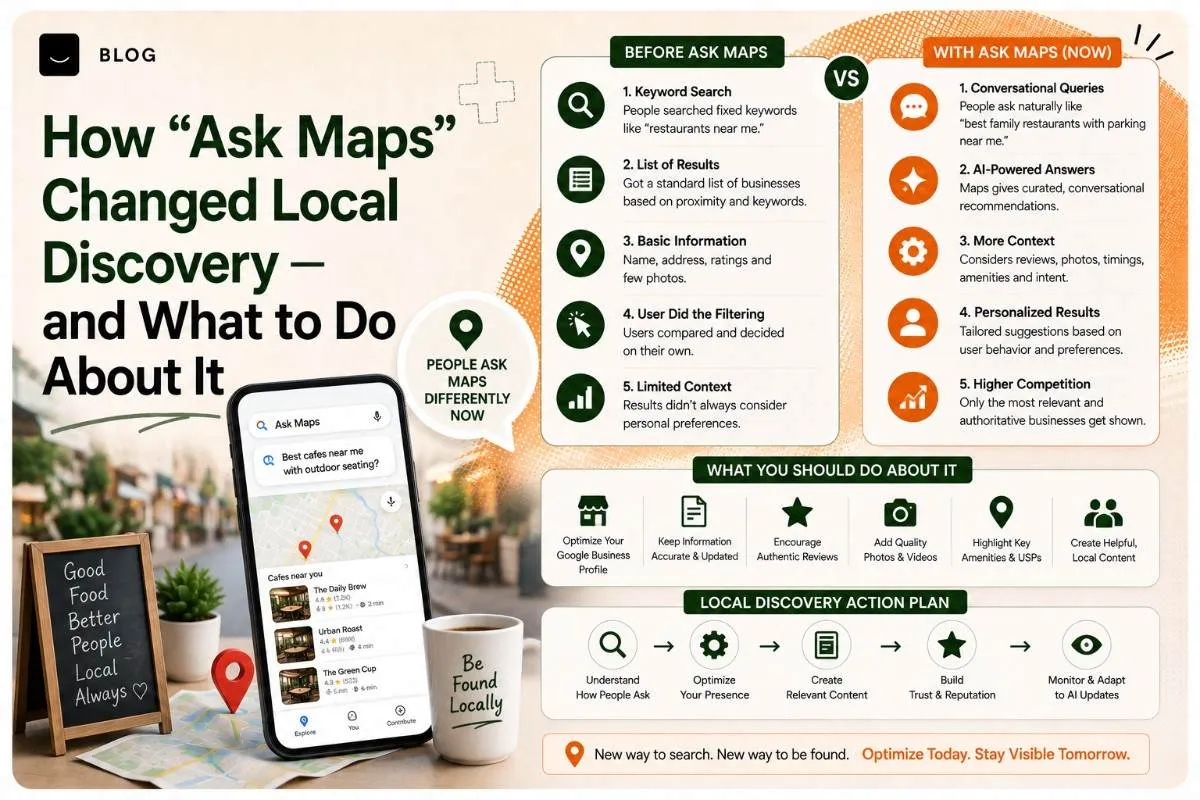
How "Ask Maps" Changed Local Discovery — and What to Do About It
Google has replaced the crowdsourced Q&A section on Business Profiles with Ask Maps, a Gemini-powered conversational feature that answers questions about a business by drawing on its profile data, its reviews, and the wider web. how AI search decides who to quote India was one of the two launch markets. The practical consequence is significant: customers now receive an AI-generated answer about your business whether or not you have done anything to shape it.
What Ask Maps is
Ask Maps is a conversational feature inside Google Maps. Instead of typing a place name or a keyword, a user taps an "Ask Maps" button below the search bar and describes what they want in ordinary language — the sort of question that never worked as a search query. It returns recommendations on a map rather than a plain list.
It also appears at the level of an individual business, where a user can ask a specific question about a place and get an AI-generated answer immediately, rather than posting a question and hoping someone replies.
Google announced the feature in March 2026 and rolled it out in the United States and India on Android and iOS, with desktop following later. By early August 2026 it had expanded well beyond those two markets.
Sources to cite in the published post:
- Google Maps rollout coverage: https://9to5google.com/2026/03/31/google-shows-how-you-should-use-ask-maps-as-the-feature-rolls-out-widely/
- Q&A retirement and API shutdown: https://www.yext.com/blog/2025/10/google-retiring-q-and-a-ai-driven-answers
- Marketer analysis of the profile-level feature: https://www.searchenginejournal.com/ask-maps-what-it-means-for-marketers/537572/
VERIFY: Re-check every date and availability claim above against Google's own help documentation on the day you publish. This feature has moved repeatedly, and secondhand blog coverage of it is inconsistent — some sources date it to late 2025, others to March 2026, because two related things happened at different times (see the next section).
What happened to Google Q&A
Two separate changes are often conflated, and getting them straight matters.
First, the old Q&A went away. Google's Q&A API access ended on 3 November 2025, and the crowdsourced Q&A section began disappearing from business profiles around the same time. If your Q&A section vanished and you assumed it was a display bug, it was not.
Second, the conversational Ask Maps feature launched in March 2026, bringing the natural-language search experience described above.
The old Q&A was a genuinely useful local SEO tool that almost nobody used properly. You could post your own questions and answer them — seeding the answers to the things customers actually ask. It was opt-in, and the businesses that bothered got a real advantage.
Ask Maps is not opt-in. It is always on, for every business, and it will answer questions about you whether you have prepared for it or not.
content freshness and AI citation
Why this matters more in India than almost anywhere else
Most global coverage of this feature treats it as a US story with an international rollout to follow. That is not what happened. India was a launch market alongside the United States, on both Android and iOS, from the beginning.
For an Indian business, that means the adaptation window that usually exists — the six or twelve months while a Google feature is US-only and you can watch what happens before reacting — did not exist here. The feature is live for your customers now.
It also lands in a market where Google Maps is doing more work than it does elsewhere. Discovery, directions, phone calls and reviews all funnel through Maps for a large share of Indian local businesses, often more than through the business's own website. A change to how Maps answers questions is therefore a change to a primary customer channel, not a secondary one.
The real shift: you no longer write the answer
This is the part worth sitting with.
Under the old Q&A, if a customer wanted to know whether you had parking, they either found a question someone had asked, or they asked one and waited. You controlled your answer, and you could pre-empt the question entirely.
Under Ask Maps, the customer asks and gets an answer immediately — assembled by Gemini from your profile, your reviews, and your website. You did not write it. You cannot edit it. You cannot see most of the questions being asked.
What you can control is the source material. That is the whole strategy, and it is exactly the Generative Engine Optimization problem in miniature: you are no longer optimising a page for a ranking, you are supplying the inputs an AI system will summarise. The businesses that do well here are the ones whose information is complete, specific, consistent and easy for a machine to read.
Where Ask Maps gets its information
Your Google Business Profile
The most direct source, and the one most businesses have half-finished. Attributes matter far more than they used to, because they are now feeding answers rather than sitting as icons. Wheelchair access, parking, payment methods, service options, hours including holiday hours — every unfilled attribute is a question the system has to answer from somewhere less reliable, or answer with "there isn't enough information about this place."
That last outcome is the one to avoid. An unanswered question is a customer who moves on.
For More :- how local search differs from national SEO
Your reviews
Review text describes your business in customer language, which is exactly the language the questions are asked in. This is a direct argument for replying to reviews with specific detaiL replying to every review with specific, factual detail rather than a generic thank-you — your replies become part of the text that describes you.
It also means a recurring complaint is now more visible than it used to be, because it is a pattern in the source material, not just one review buried on page three. Fixing the underlying problem matters more than it did.
Your website
Your website is the source you fully control, and it is where structured, explicit information pays off. A clear services page, a contact page with complete address details, location pages for multiple branches, and — critically — an FAQ that answers the questions your Q&A section used to.
What to do about it — a practical checklist
- Complete every field and attribute on your Google Business Profile. Not most. Every one. This is unglamorous, takes an afternoon, and is the highest-return item on this list.
- Fix your hours, including special hours for holidays and festivals. Wrong hours in an AI answer produce an annoyed customer standing outside a closed shop.
- Move your old Q&A content onto your website as an FAQ page. If you had seeded Q&As, that content still has value — it just needs a new home where crawlers can read it.
- Add FAQPage schema to that page. Structured data makes the answers machine-readable rather than merely present.
- Reply to every review with specific detail. Name the thing the customer named; add one concrete fact they did not mention.
- Make sure your NAP is identical everywhere — profile, website, directories. Conflicting information is a reason for an AI system to hedge or get it wrong.
- Write the answers to questions you actually get asked. Not the questions you wish customers asked. Your front desk or phone line already knows what they are.
- Check what the system currently says about you — the method is in the next-but-one section.
The FAQ page is now doing a job it never used to do
For years, an FAQ page was a slightly tired SEO recommendation. Its status has changed.
With the Q&A section gone from your profile, your website's FAQ is now the place where your answers to customer questions live in a form Google can read. It is no longer a nice-to-have page for people who scroll; it is source material for a system that will answer on your behalf.
Practical implications for how you write it:
- One question per heading, phrased the way a customer would say it. "Do you have parking?" not "Parking facilities."
- Self-contained answers, roughly 40 to 70 words. An answer that only makes sense in the context of the answer above it is harder to extract.
- Specific and factual. "We have parking for eight cars at the rear, free for customers" is usable. "Parking is available" is barely better than nothing.
- FAQPage schema on the page.
- Kept current. A wrong FAQ answer is now a wrong AI answer.
How to test what Ask Maps says about you
Do this yourself, on a phone, in about fifteen minutes:
- Open Google Maps on a mobile device and find your own business profile.
- Ask it the five questions your customers ask most often.
- Write down what it says. Note anything wrong, vague, or answered with a version of "not enough information."
- For each gap, identify which source should have supplied it — profile attribute, review text, or website — and fix that source. running an AI visibility audit
- Repeat in six weeks.
Then do the same from the other side. Use the Ask Maps search bar to ask the sort of question a customer would ask when they do not yet know your name — "quiet café near the lake with good wifi," "solar installer in Bhopal that handles subsidy paperwork." See who comes back. If it is not you, look at what the businesses that did come back have in common.
That exercise is worth more than any general advice, including this article.
What this does not mean
A few honest limits, because there is already a lot of overclaiming about this feature:
- This is not a ranking factor you can optimise directly. There is no Ask Maps score. You are improving the accuracy and completeness of what the system reads.
- You cannot see the questions customers ask. There is no reporting dashboard for this. Anyone offering you Ask Maps analytics should be asked exactly where the data comes from.
- You cannot edit the answers. Only the inputs.
- Feature availability moves. What is true of Ask Maps this quarter may not be next quarter, which is why this post carries a last-updated date and gets reviewed quarterly.
None of the work above is wasted even if the feature changes again. A complete profile, consistent NAP data, a real FAQ page and answered reviews are the same foundation every AI answer engine reads from — Gemini today, whatever follows it next. Crescent's local search and GEO work
Frequently asked questions
Ask Maps is a Gemini-powered conversational feature in Google Maps that lets users ask questions in natural language and receive AI-generated answers and recommendations. It operates both as a search experience — asking for the kind of place you want rather than naming it — and at the level of an individual business profile, where users can ask specific questions about a place.
Yes. Google's crowdsourced Q&A feature on Business Profiles was retired, with API access ending in November 2025, and AI-generated answers took its place. The key difference is that Q&A was opt-in and businesses could seed their own answers, whereas Ask Maps answers automatically using profile data, reviews and web content, whether the business has prepared or not.
Yes. India was one of the two launch markets alongside the United States when the conversational feature rolled out in March 2026, on both Android and iOS. This was unusual — most Google Maps features reach India well after a US-only period — and it means Indian businesses did not get the usual lead time to adapt.
You cannot edit the answers directly, only the sources they are generated from. That means completing every field and attribute on your Google Business Profile, keeping hours accurate, replying to reviews with specific factual detail, and maintaining a clear FAQ page on your website with FAQPage schema.
Existing Q&A content was not simply discarded — historical Q&A data has been incorporated into the context Ask Maps draws on. However, the interface for posting and managing pre-seeded questions is no longer available in its old form, so that content should now be maintained on your own website instead.
More than before, in one specific way. Your website is the source you fully control, and it is where an AI system looks for information your profile does not carry — service detail, policies, and the answers your Q&A section used to hold. A clear services page, complete contact details and a well-structured FAQ page all become source material.
No. There is no reporting available for the questions asked through Ask Maps. The practical alternative is to test it yourself: ask your own profile the questions you know customers ask, note what comes back, and fix whichever source produced a wrong or missing answer.
Ready to build what's next?
Tell us where you're headed. We'll come back with a plan to get there.
Book an intro call