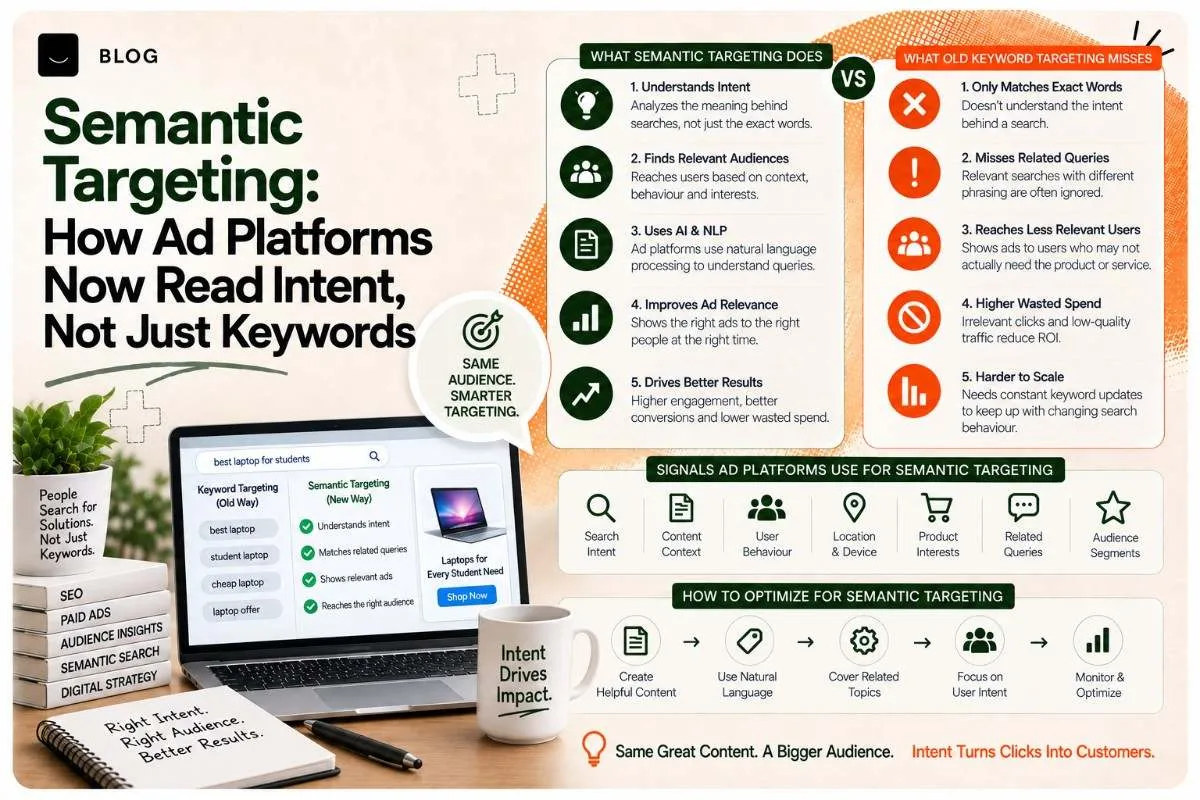
Semantic Targeting: How Ad Platforms Now Read Intent, Not Just Keywords
Ad platforms increasingly match ads to searches by interpreting what a query means rather than by matching keyword strings. A campaign can therefore serve on searches whose words appear nowhere in your keyword list. This changes what an advertiser actually controls — and most accounts are still built around controls that have quietly stopped being the main lever.
What changed
The old model was mechanical and legible: you listed keywords, chose a match type, and the platform matched the query against your string with defined rules. Exact meant exact. You could reason about it.
The current model interprets. The system builds an understanding of what a query means and what your ads, keywords, landing pages and assets are about, then decides whether those meanings correspond. Match types still exist and still constrain, but they operate on meaning rather than on characters — which is why advertisers regularly see traffic on searches sharing no words with their keyword list.
The practical consequence: your keyword list has shifted from being an instruction to being a signal. It tells the platform what you are about. It no longer defines the boundary of what you will serve on.
VERIFY: Ad platform features and their names change frequently, and terminology differs between Google and Meta. Before publishing, verify every named feature against the platform's current documentation and remove anything that has been renamed or retired. Do not name a feature you have not confirmed exists today.
Why platforms moved this way
Three reasons, and understanding them predicts where this goes next.
Most queries are new. A large share of searches have never been seen before in exactly that form. String matching cannot serve them; interpretation can.
Conversational and voice queries are longer and messier. "Which solar company near me will handle the subsidy paperwork" is not a keyword. It is a sentence with an intent inside it.
It suits the platforms commercially. Broader matching means more auctions entered and more inventory monetised. This is not a conspiracy — it genuinely does serve advertisers who were leaving relevant traffic unbid — but it is worth naming plainly, because it explains why the defaults lean broad and why advertiser controls have narrowed rather than widened.
What this breaks in how most accounts are still run
Four habits that were correct five years ago and now work against you.
Tight keyword-themed ad groups
The single-keyword ad group structure existed to control which ad showed for which query. If the platform is interpreting meaning, dozens of near-identical ad groups fragment your data across too many small buckets, slow learning, and control less than they used to.
Consolidation is usually the right direction now — grouped by intent and by landing page rather than by keyword string.
Negative keyword lists as the primary control
Negatives still work and still matter. But a negative list blocks specific strings, and semantic matching serves on meanings. You end up playing whack-a-mole with variations while the underlying mismatch persists.
Negatives are now a corrective tool, not the steering wheel.
Ad copy written to mirror the keyword
Stuffing the keyword into the headline was a relevance signal in a string-matching system. In a meaning-based system, copy that reads like a keyword insertion is just worse copy — less persuasive to the human reading it, and no more matchable to the machine.
Landing pages that only match the exact query
If your ad can serve on a wider range of related intents, a landing page that answers exactly one narrow query will fail a proportion of the traffic it receives. The page needs to satisfy the intent cluster, not a single string.
What actually controls a semantic campaign now
The controls have moved. In rough order of leverage:
- Conversion data quality. This is the primary lever, and it is not a targeting setting. What you tell the platform counts as a conversion determines what it optimises toward. Counting a form fill and a qualified lead identically will get you form fills. Feeding back which leads actually became customers changes what the system chases.
- Landing page content. The page is now a targeting input, not just a destination. What it is about informs what the platform thinks your ad is about.
- Ad copy and assets as meaning signals. Your creative describes your offer to the system as well as to the customer.
- Audience and exclusion signals. Who you tell the platform to prioritise and exclude.
- Campaign and budget structure. Separating things that must not compete for the same budget.
- Negatives. Still useful, still necessary, no longer primary.
- Match types. A constraint on breadth rather than a definition of matching.
Notice that the top two are things most agencies treat as somebody else's job. That is the real shift.
Writing ad copy for meaning-based matching
Practical guidance that differs from the old rules:
- Write for the human first. In a meaning-based system there is much less tension between "written for the algorithm" and "written well." Clear, specific copy is both.
- Be specific about what you actually offer. Vague copy gives the system a vague understanding of your offer, which produces vaguer matching. "Rooftop solar installation with subsidy paperwork handled" describes your intent space far better than "affordable solar solutions."
- State qualifiers and exclusions in the copy. Minimum order values, service areas, who you do not serve. This filters clicks before they cost you, and it tells the system what you are about.
- Vary your assets meaningfully. Several near-identical headlines teach the system nothing. Genuinely different angles let it learn which intent responds to which framing.
- Drop mechanical keyword insertion unless it is genuinely improving relevance for the reader.
The old skill was matching copy to keyword. The new skill is describing your offer precisely enough that a machine reading it forms an accurate picture.
The landing page's new job
Three requirements, and they overlap substantially with good SEO — which is worth noticing.
Cover the intent cluster. If the ad serves across related intents, the page should address that cluster — usually through clear sections and a short FAQ rather than through a longer sales pitch.
Be explicit about what you are. Stated plainly, near the top. The same directness that makes a page snippet-eligible makes it legible to an ad platform's understanding of your offer.
Qualify honestly. Say who this is for and who it is not. Wasted clicks cost real money, and a page that filters costs less than a negative keyword list maintained forever.
This is the point where paid and organic stop being separate disciplines in practice. The page that ranks well and the page that supports a semantic ad campaign are converging on the same characteristics: clear, specific, complete, honest about scope.
What has not changed, and is being wrongly abandoned
Some fundamentals are being discarded because "the algorithm handles it." It does not.
- Conversion tracking accuracy. More important than ever, because it is now the primary control. Broken tracking with automated bidding is worse than broken tracking with manual bidding.
- Search terms review. Still essential. Read what you actually served on, weekly. This is how you catch semantic drift, and it is skipped constantly.
- Budget discipline. Broader matching spends faster. Automation does not protect you from spending on the wrong things at pace.
- Offer quality. No targeting sophistication fixes an offer nobody wants.
- Honest reporting. Attribution has become harder, not easier. Report what is measurable and say what is not.
A practical audit of your own account
An afternoon's work:
- Pull the last 90 days of search terms. Read them, do not skim. Note what proportion you would have chosen to bid on.
- Count your ad groups. If you have more than a handful per campaign and they are keyword-themed rather than intent-themed, consolidation is probably overdue.
- Check what you count as a conversion. If every action is weighted equally, that is your biggest problem and it is not a targeting problem.
- Read your own ad copy as a stranger. Does it describe what you actually offer, specifically? Or is it keyword-shaped?
- Open your landing pages and read the first paragraph. Would someone with a related-but-not-identical intent find what they came for?
- Check whether qualifying information is on the page — service area, minimum spend, who you do not serve.
Items 3, 4 and 5 usually produce more improvement than any bidding change.
Frequently asked questions
Semantic targeting is when an ad platform matches ads to searches by interpreting what a query means rather than by matching keyword strings. Your ads can serve on searches sharing no words with your keyword list, because the system judges that the intent behind the query corresponds to what your ads and landing pages are about.
Yes, but their role has changed. A keyword list now functions as a signal describing what your business is about rather than as an instruction defining exactly what you serve on. Match types still constrain breadth, but they operate on meaning rather than on characters.
Yes, but they are no longer the primary control. Negatives block specific strings while semantic matching serves on meanings, so a negative list tends to catch variations one at a time while the underlying mismatch persists. Treat them as a corrective tool alongside better conversion data, clearer copy and landing pages that qualify honestly.
Write for the human, and be specific about what you actually offer, including qualifiers and exclusions. Vague copy gives the platform a vague understanding of your offer and produces vaguer matching. Mechanical keyword insertion no longer helps and usually makes the copy worse for the reader.
Yes. The landing page is now a targeting input rather than only a destination, because what the page is about informs the platform's understanding of what your ad is about. Pages should cover the related intent cluster, state plainly what the offer is, and qualify who it is and is not for.
Conversion data quality. What you tell the platform counts as a conversion determines what it optimises toward, so counting a form fill and a qualified customer identically will produce form fills. Feeding back which leads actually converted changes the outcome more than most targeting settings.
Usually, yes. Tightly themed single-keyword ad groups existed to control which ad showed for which query, which matters less when matching is meaning-based. Many small ad groups fragment conversion data and slow learning. Group by intent and by landing page instead.
Ready to build what's next?
Tell us where you're headed. We'll come back with a plan to get there.
Book an intro call