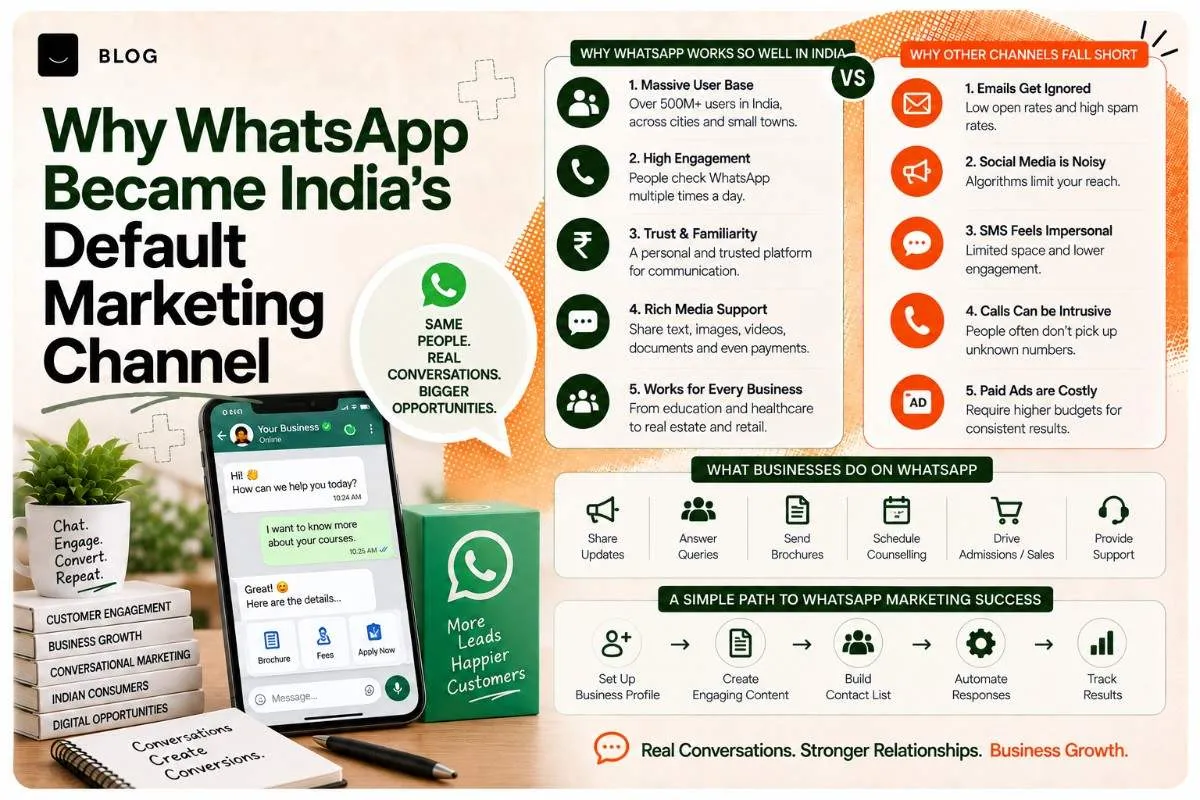
Why WhatsApp Became India's Default Marketing Channel
In most markets the default customer-communication channel is email. In India it is WhatsApp — for enquiries, follow-ups, order updates, support, payments and increasingly the entire transaction. This post covers why that happened, what the channel is genuinely good and bad at, where the line sits between useful and intrusive, and one significant blind spot that almost nobody accounts for.
The short version
WhatsApp won because it matched how Indian customers already behaved. It arrived early, worked on cheap phones and poor connections, cost nothing to use, and required no new habit. By the time businesses started thinking of it as a marketing channel, customers were already using it to contact them.
That last point is the one that matters strategically. Most channels have to be built. This one had to be caught up with.
VERIFY: Do not add user-count or penetration statistics to this post without a named primary source and a date. Widely-quoted India WhatsApp figures circulate without attribution and are frequently years out of date. The argument does not need a number.
Why email never took hold here the way it did elsewhere
Worth understanding, because it explains what will and will not transfer from Western marketing playbooks.
Mobile-first, not mobile-also. A large share of Indian internet users came online on a phone, without a prior desktop-email habit. Email was a work tool or an account-registration requirement rather than a place where personal communication happened.
Language and keyboard friction. Typing an email in English is a different task from sending a voice note or a quick message in your own language. WhatsApp accommodates voice, images, and mixed-script typing in a way email conventions never did.
Trust lives in the contact list. A message from a saved contact reads differently from an email from a brand. That is an advantage and, as covered below, a responsibility.
Businesses were already there. Small Indian businesses ran on WhatsApp before any of this was a marketing conversation — sharing catalogues in groups, taking orders in chat, sending payment confirmations. The infrastructure followed the behaviour.
The implication: importing an email-marketing playbook into WhatsApp — list-building, broadcast frequency, campaign calendars — produces exactly the behaviour that gets businesses blocked. The channels are not equivalent.
What WhatsApp is genuinely good at
- Transactional and expected messages. Order confirmations, appointment reminders, delivery updates, payment receipts. Genuinely useful, genuinely wanted, and the reason most people tolerate business messages at all.
- Two-way conversation at the point of decision. A customer with one blocking question gets an answer in minutes. That is a conversion mechanism, not a marketing message.
- Rich media without friction. Photographs, documents, voice notes, location. A property brief, a product photo, a prescription clarification — all natural here and awkward elsewhere.
- Reaching people who will not open an app. No download, no login, no new account.
- Regional-language communication. Including voice, which removes literacy and keyboard barriers entirely.
What WhatsApp is genuinely bad at
Honest limits, because most writing on this subject is promotional.
- Broadcast marketing. It tolerates a small amount and punishes more. The channel's value comes from feeling personal; volume destroys that, and the punishment is a block, which is permanent.
- Discovery. Nobody finds a business on WhatsApp. It converts and retains demand created elsewhere. Treating it as an acquisition channel is a category error.
- Anything requiring a considered read. Long-form explanation, comparison, detailed documentation — these belong on a page you can link to.
- Measurement. Attribution is poor, and the reporting available is thin compared with email or paid media.
- Being a system of record. Conversations scatter across staff phones unless you use a proper business platform. This is an operational risk long before it is a marketing one.
The line between a channel and a nuisance
The distinction that decides whether this works:
Useful: the customer asked for it, expects it, or would be worse off without it. Order updates. Appointment reminders. A reply to their question. Something they specifically requested.
Tolerated: relevant, occasional, and easy to stop. A genuine update to a customer who has bought recently.
A nuisance: unrequested promotional broadcasts, high frequency, irrelevant offers, and anything the recipient cannot easily stop.
The asymmetry is what makes this different from email. An ignored email costs you nothing much. A blocked WhatsApp contact is a customer you can no longer reach through the channel they actually use — and often a report against your number.
A practical rule: if you would not send this message to one specific customer by name, do not send it to a thousand.
The rules that actually apply
Platform policy
WhatsApp's business messaging policy governs what you may send, what requires opt-in, how template messages work, and what gets a number restricted or banned. It is enforced, and enforcement lands on the number your customers contact you on.
Two practical points that catch businesses out: messages initiated by a business are treated differently from replies inside a customer-initiated conversation, and using personal WhatsApp or unofficial bulk tools to do business messaging risks the number entirely.
VERIFY: Link WhatsApp's current business messaging policy directly and confirm the specifics before publishing. Do not paraphrase the rules from memory or from another agency's blog — this is the kind of detail that changes and that readers will act on.
Consent and data protection
India's data protection framework creates obligations around consent, purpose limitation and the handling of personal data, and marketing communication sits squarely inside that.
VERIFY: This section requires legal verification before publishing. Confirm the current status and applicable obligations of India's data protection legislation, including which provisions are in force and any rules notified under it. Do not state compliance requirements that have not been verified, and consider having a lawyer review this section. Crescent's stated editorial position is that unverifiable regulatory claims are not published — this is exactly such a case.
The safe general guidance, independent of the specific legal position: collect explicit consent, record when and how it was given, state clearly what you will send, make opting out genuinely easy, and honour it immediately.
How to think about channel mix
WhatsApp is a conversion and retention channel. It is not an acquisition channel. That single distinction resolves most of the confusion.
A workable division of labour:
- Search, AI answers and paid media create demand and bring people who do not know you
- Your website does the explaining, comparing and qualifying
- WhatsApp handles the conversation that closes it, and the relationship afterwards
The failure mode is using WhatsApp for the middle job. Long explanations, price comparisons and detailed capability information do not belong in a chat thread — they belong on a page, which the chat links to.
The blind spot: WhatsApp content is invisible to search and AI
This is the part almost nobody accounts for, and it connects directly to the biggest structural problem facing Indian businesses in AI search.
An enormous amount of genuine, valuable business information in India exists only inside WhatsApp. Pricing explained in a chat. Product details in a broadcast. The answers your team gives to the same twenty questions every week. Catalogues shared as images in groups.
None of that is on the open web. Search engines cannot index it, AI answer engines cannot cite it, and no future customer can find it. From the point of view of the systems increasingly deciding who gets recommended, that information does not exist.
The fix costs almost nothing: whenever you find yourself explaining the same thing in WhatsApp for the fifth time, publish it as a page on your website — then send the link. You answer faster, the customer gets something they can re-read and forward, and the explanation becomes findable content working for you permanently.
This single habit converts your most active channel into a content pipeline. It is the highest-leverage thing in this post.
What to measure
Modestly, because the data is limited:
- Response time. The metric that most affects whether the channel works, and the one you fully control.
- Enquiry-to-conversation rate. How many people who message you get a real reply, not an automated acknowledgement.
- Block and report rate. The clearest signal that you have crossed the line. Watch it closely; treat any rise as a stop signal.
- Opt-out rate, tracked honestly rather than made hard to trigger.
- Conversations that produced business, tracked at whatever granularity your setup allows.
Resist the metrics that flatter: broadcast delivery counts and template send volumes measure how much you sent, not whether it worked.
Frequently asked questions
It matched existing customer behaviour rather than requiring a new habit. India's internet growth was mobile-first without a prior desktop-email culture, WhatsApp worked on inexpensive phones and poor connections, and small businesses were already using it for orders and enquiries before it was treated as a marketing channel.
They do different jobs. WhatsApp is better for transactional messages, two-way conversation at the point of decision, and rich media in regional languages. Email remains better for long-form content, documentation and anything requiring a considered read. Treating WhatsApp as an email list and broadcasting to it is the most common and most damaging mistake.
Within limits, with consent, and following the platform's business messaging policy. Business-initiated messages are treated differently from replies within a customer-initiated conversation, and unofficial bulk-messaging tools risk the number entirely. The practical constraint is stricter than the policy: an unwanted message earns a block, which permanently removes your access to that customer.
No. Nobody discovers a business on WhatsApp. It converts and retains demand created elsewhere through search, AI answers, referral or paid media. Treating it as an acquisition channel misunderstands what it does.
Importing an email playbook — building a list and broadcasting to it on a schedule. The channel's value comes from feeling personal, and volume destroys that. A useful test: if you would not send the message to one named customer individually, do not send it to a thousand.
No, and this is a widely overlooked cost. Information that exists only inside WhatsApp cannot be indexed by search engines or cited by AI answer engines. Whenever you explain the same thing in chat repeatedly, publish it as a page on your website and send the link instead — you answer faster and the explanation becomes findable.
Response time, the proportion of enquiries that receive a real reply, block and report rate, opt-out rate, and conversations that produced business. Avoid relying on delivery and send volumes, which measure how much you sent rather than whether it worked.
Ready to build what's next?
Tell us where you're headed. We'll come back with a plan to get there.
Book an intro call